
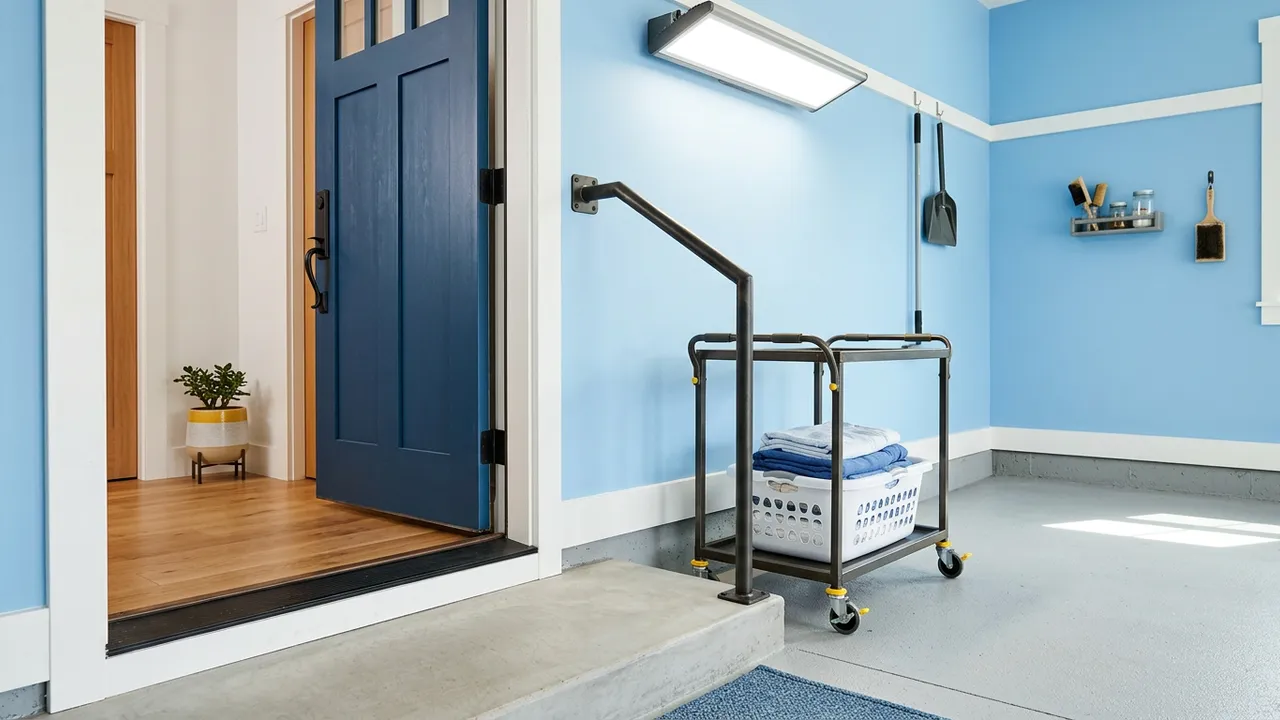
Garage and laundry trips combine several fall risks at once: a step down, a hard floor that may be uneven or slick, poor lighting and something heavy in your arms. The fixes are simple. Carry smaller loads, light and mark the step, put a rail or grab bar by the door and keep the floor clear.
Why these trips are riskier than they look
These are everyday chores, so we rarely think about them. But look at what is happening:
- You are often carrying something (a basket, groceries, trash) that blocks your view of your feet and ties up your hands.
- There is often a step or threshold between the house and the garage.
- The garage floor may be uneven, slick or cluttered.
- Lighting is often dim, and the switch may be on the far side.
- You may be alone, out of earshot of the rest of the house.
The step into the garage
- Add a rail or grab bar beside the door. An outdoor grab bar by the door helps you steady yourself while you open it.
- Mark the step and threshold with contrasting tape so the edge stands out. Older eyes need about three times as much contrast to see an edge.
- Light it. A motion light that turns on as you open the door is ideal.
- Put a small bench or shelf by the door to set packages down, so you have a free hand for the door and the rail.
- Consider a threshold ramp if the step is small and a walker is involved. See What's the difference between a ramp, a threshold ramp and a lift?
The garage itself
Common garage hazards and fixes:
- Uneven or slick floors: repair cracks and clean up oil or water.
- Shoes piled by the door: give shoes one designated spot, off the walking path.
- Loose items on shelves: secure shelving so things cannot fall or tempt you to climb.
- Cords and hoses: coil them and store them off the floor.
- Lighting: brighter fixtures make a real difference.
Wet entries are a common Tampa Bay issue in the rainy season. Wipe shoes and floors when you come in from a storm.
Laundry: lighter loads, safer trips
- Use a laundry cart with wheels and handles, not a basket you have to carry. A cart you push gives you something steady to hold and keeps your view of the floor clear. A basket in your arms blocks your view of your feet and takes your hands away from rails.
- If you do have to carry, carry less. Two light trips are safer than one heavy one. Hold the load close to your body.
- Keep a hand free for a rail or the doorframe whenever you can.
- Light the laundry area well, including inside dark cabinets.
- Keep the floor clear of cords, detergent jugs and dropped clothing, so the cart rolls freely.
- Store detergent at waist to shoulder height, so you are not bending low or reaching high.
If the laundry is down a staircase, a cart will not help on the stairs themselves. Add rails on both sides and paint the floor at the bottom of the stairs a contrasting color. When the last step matches the floor, it is easy to misjudge.
Bring the laundry closer
In some homes, the right answer is to move the laundry itself. Clothes come off and get put away in the bedroom, so a washer and dryer on that same level, as close to the bedroom as possible, takes the stairs and the long carry out of the job entirely. A stackable washer and dryer can often fit in a closet or hall alcove. It is a bigger project that needs plumbing and electrical work, but for someone who does laundry every week on a basement or garage staircase, it can be one of the most worthwhile changes in the house.
Consider handing it off
Laundry is also a reasonable chore to delegate. A family member, a neighbor, a home aide or a laundry pickup service can take it on. Handing off one heavy, risky job is not giving up independence. It saves your energy, and your balance, for the things that matter most to you, so you can keep doing them on your own.
Watch your attention
Carrying laundry while talking, checking the phone or thinking about the next task splits your attention. That "dual tasking" is a known fall risk. Let the phone ring and give the step your full attention.
At the same time, everyday chores are good exercise. Folding laundry and carrying light loads keep you strong and moving. The goal is to keep doing these jobs, safely.
Keep a phone with you
If you fall in the garage, no one may hear you. Keep a phone on your body, not on the kitchen counter. A medical alert button, ideally with automatic fall detection, is another option. Many older adults wait too long to press it, so practice. Technology is optional and never replaces a family member or neighbor who checks in regularly.
Pets and the door
Dogs and cats love to slip through the garage door at your feet. Train pets to stay back, or use a gate, especially when your hands are full.
Signs these trips are getting harder
Notice if you or your parent:
- Hold on to the car, walls or washer to get around
- Avoid the garage or laundry, or wait for someone else to do it
- Need to push with hands to stand up after bending
- Feel lightheaded when standing up from bending over the dryer
Any of these is worth mentioning to the doctor. A physical therapist can help with strength and balance.
How Home Safety Solutions can help
On a home safety visit, we follow the real routes your parent uses, including the garage, laundry and side doors, and watch how they carry, bend and step. Then we suggest changes ranked from free to larger projects. Learn what happens during a home safety visit. Call (813) 365-9171 or email info@homesafety.solutions.
Related reading: Safety squad: getting grandkids involved · Five ways your home can help a parent stay independent · I've fallen and I can't get up · Is it normal to fall as you get older?
This article is general education, not medical advice. Talk with your doctor, pharmacist, or therapist about your own situation.