
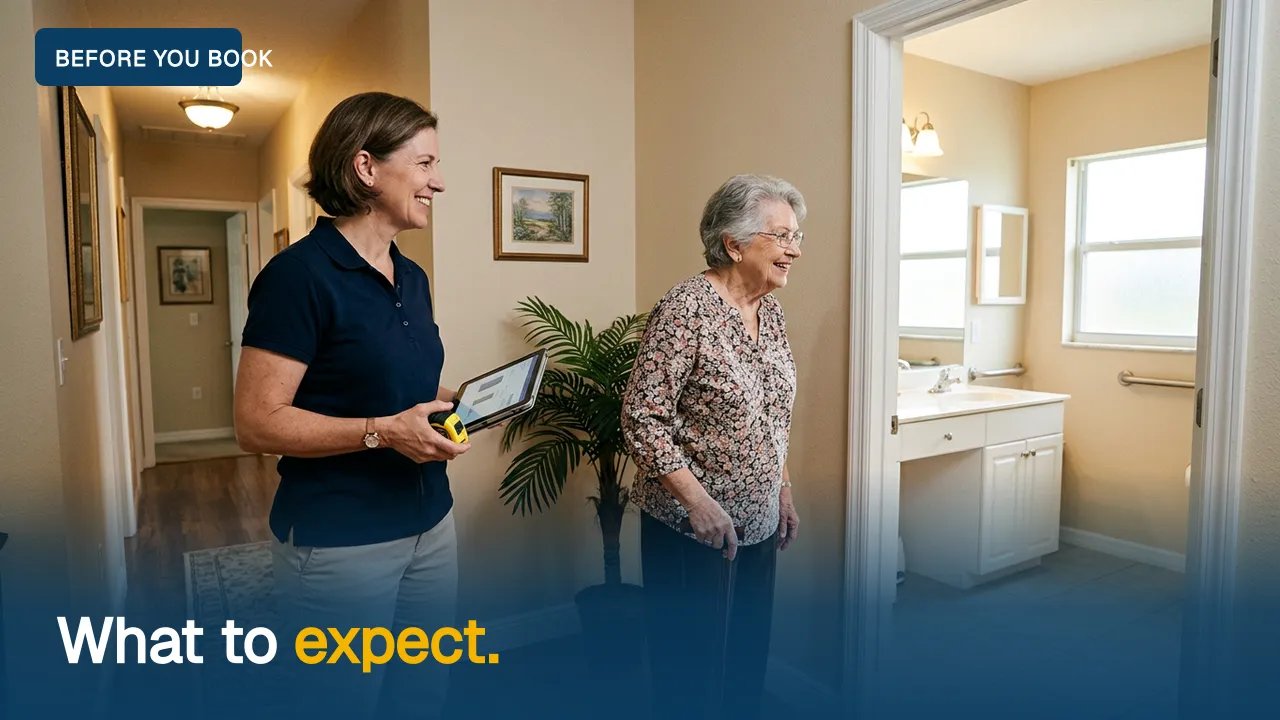
A home safety visit has three parts: a short phone call to plan it, a one-to-two-hour visit where we look at both the person and the home, and a written report with photos and a prioritized list of what to fix. Nothing is sold during the visit. You leave with a plan you can take to any contractor, or do yourself.
Before the visit
Every service starts with a 30-minute Initial Consultation by phone. We talk about what prompted the call, such as a recent fall, a hospital stay or a move. We decide which visit fits and who should be there.
What to have ready:
- A current list of medications, including sleep aids and over-the-counter products
- Any walker, cane, wheelchair, shower chair or other equipment already in the home
- Hospital or rehab discharge papers, if there was a recent stay
- The shoes your parent usually wears at home
- A family member or caregiver present, in person or by phone
- Pets secured, and a list of your own questions
During the visit
Most visits take 60 to 120 minutes. They have two halves.
1. A look at the person
A home is only safe or unsafe for a particular person, so we start there. We use screening tools from the CDC's STEADI fall prevention program, which physical therapists and physicians use nationwide.
| Test | What it shows | A sign of higher fall risk |
|---|---|---|
| Stay Independent questionnaire | 12 yes-or-no questions about falls and balance | A score of 4 or more |
| Timed Up and Go | Time to stand, walk 10 feet, turn and sit | 12 seconds or longer |
| 30-Second Chair Stand | Leg strength | Below the average for age and sex |
| 4-Stage Balance Test | Standing balance in four foot positions | Unable to hold the heel-to-toe position for 10 seconds |
We also talk about vision, dizziness, medications, night-time bathroom trips and what daily tasks have become hard.
2. A walk through the home
Then we go room by room with the person, watching them do the things they do every day. We watch them get in and out of the house, on and off the bed and toilet, into the shower, and through the kitchen. Occupational therapists and physical therapists use structured home assessment tools to do this consistently. Examples include the Westmead Home Safety Assessment and SAFER-HOME, which covers areas such as mobility, toileting, medications and emergency communication.
We measure doorways, steps, thresholds, bed and toilet heights, and lighting. We photograph each concern.
After the visit
You receive a written report that includes:
- A photo report of each concern, room by room
- A prioritized hazard list: what to fix before anything else, what to fix within a month, and what can be planned
- Specific recommendations, such as which grab bar, where, and at what height
- Suggestions for equipment, training and follow-up with the person's doctor or therapist where appropriate
If you want a contractor to price the work, we can prepare a separate Modification Prescription. It lists specifications, measurements and photo references, with no health information. You choose your own contractor and pay them directly. We accept no referral fees.
Privacy
The visit involves health information, and we protect it under HIPAA. If you want the report shared with family members, we will ask for a signed release naming who may receive it.
Ready to start?
Book an Initial Consultation. Current prices are on our pricing page.
Sources
- Centers for Disease Control and Prevention. STEADI clinical resources
- CDC STEADI. Stay Independent brochure
- CDC STEADI. Timed Up and Go
- CDC STEADI. 30-Second Chair Stand
- CDC STEADI. 4-Stage Balance Test
- Chiu T, Oliver R. SAFER-HOME assessment
- Clemson L, et al. (1999). Reliability of the Westmead Home Safety Assessment. OTJR.
- American Physical Therapy Association, ChoosePT. Physical therapy guide to falls