
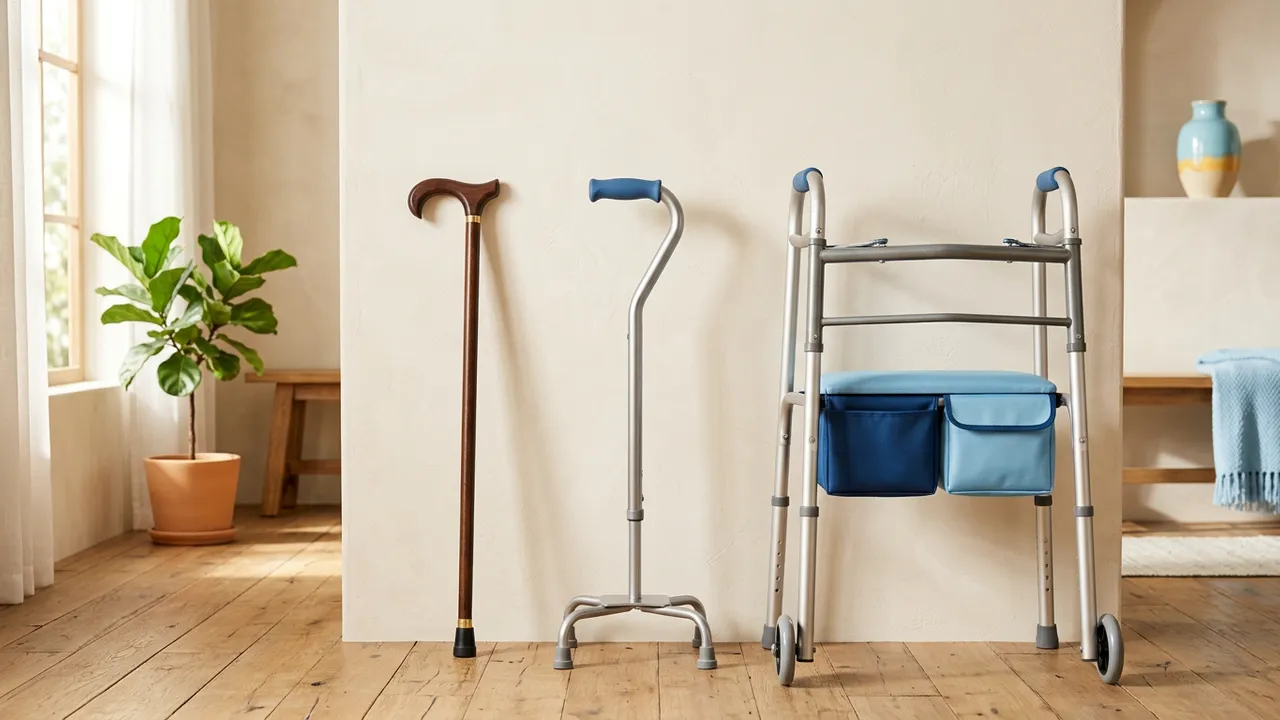
The right mobility aid, sized correctly and taught well, helps prevent falls. The wrong one, a damaged one, or one you were never shown how to use can cause them. The best choice is the least restrictive device that keeps you safe, and the best person to help you pick it and set its height is a physical or occupational therapist.
First, a word about needing one
Many people put off a cane or walker because of how it looks or because they feel "not me, not yet." That is common. But if you have been advised to use a cane or walker, that advice is itself a sign that your fall risk is higher. Using the device well is a way to keep doing what you want, not a sign of giving up.
The main options
- Cane (walking stick). The lightest option, for people who need a little extra support.
- Lofstrand (forearm) crutches. An alternative a therapist may suggest for some people.
- Two-wheel walker. Wheels in front only, so it does not roll as freely as a four-wheel model.
- Four-wheel rollator. Has a seat and hand brakes and rolls easily. That is also the risk: it can roll in many directions, and brakes are often not used or not working. They are often a poor choice for people with poor control.
- Rollator with locking rear legs. A middle ground for some people.
- Stabilizing walkers, such as the U-Step 2, with a U-shaped base and reverse braking. Some models add laser and sound cueing for people with Parkinson's freezing.
A therapist will match the device to your strength, balance, thinking, and where you use it.
Getting the height right
Height and fit matter as much as the type. Because bodies, shoes, and devices differ, have a physical or occupational therapist measure and set the height while you wear the shoes you walk in most.
Have the height rechecked:
- At every therapy or home safety visit.
- When you switch to different shoes.
- After a fall, a hospital stay, or a change in how you walk.
Check the device itself
Worn or broken equipment causes falls. Look over your device often:
- Tips: rubber tips wear smooth. Replace them when worn.
- Loose parts: check buttons, screws, and height adjusters.
- Brakes: on a rollator, test that the brakes hold every time.
- Wheels and glides: make sure they roll and slide smoothly.
Learn to use it everywhere you go
A device only helps if you use it the right way, in the real places you go. Ask your therapist to practice:
- Turning, especially tight turns in the kitchen and bathroom.
- Doorways and thresholds, including the lanai slider track.
- Curbs and steps, including the step down into a sunken living room.
- Sitting down and standing up from your chair, bed, toilet, and car.
Use your device indoors too, not just outside. Some people use a cane only when they leave the house, then walk without it at home.
Make room for it at home
- Clear paths at least 36 inches wide, wider for walkers.
- Remove or secure throw rugs, which catch walker legs and cane tips.
- Light the route from bed to bathroom so you can see where the device lands.
- Keep the device within reach of the bed and your favorite chair.
Helpful extras
Smaller tools can cut down on risky bending and reaching: bed canes, couch canes, car canes, standing canes with trays, transfer benches, reachers, elastic shoelaces, and sock aids. If you use a wheelchair, always lock the brakes before you stand or sit; in care homes, rising from an unlocked wheelchair is one of the most common moments for a fall.
Who pays
Canes, walkers, and wheelchairs are durable medical equipment (DME). They may be covered under Medicare Part B when ordered by your clinician and supplied by a Medicare-enrolled supplier; you usually pay about 20% coinsurance after the Part B deductible. See Medicare's DME coverage page. FAAST (844-353-2278) offers assistive technology loans, demonstrations, and reuse programs in Florida.
How Home Safety Solutions can help
During a home visit, we watch you use your device in your own home: the turns, doorways, thresholds, and transfers you face every day. We check fit and condition and recommend changes to the device or the house. Learn what happens during a home safety visit. Call (813) 365-9171 or email info@homesafety.solutions.
Related reading: How do I make a sunken living room safe for a walker? · Is a lanai sliding door a fall risk? · Find a physical therapist (ChoosePT) · Is it normal to fall as you get older?
This article is general education, not medical advice. Talk with your doctor, pharmacist, or therapist about your own situation.