
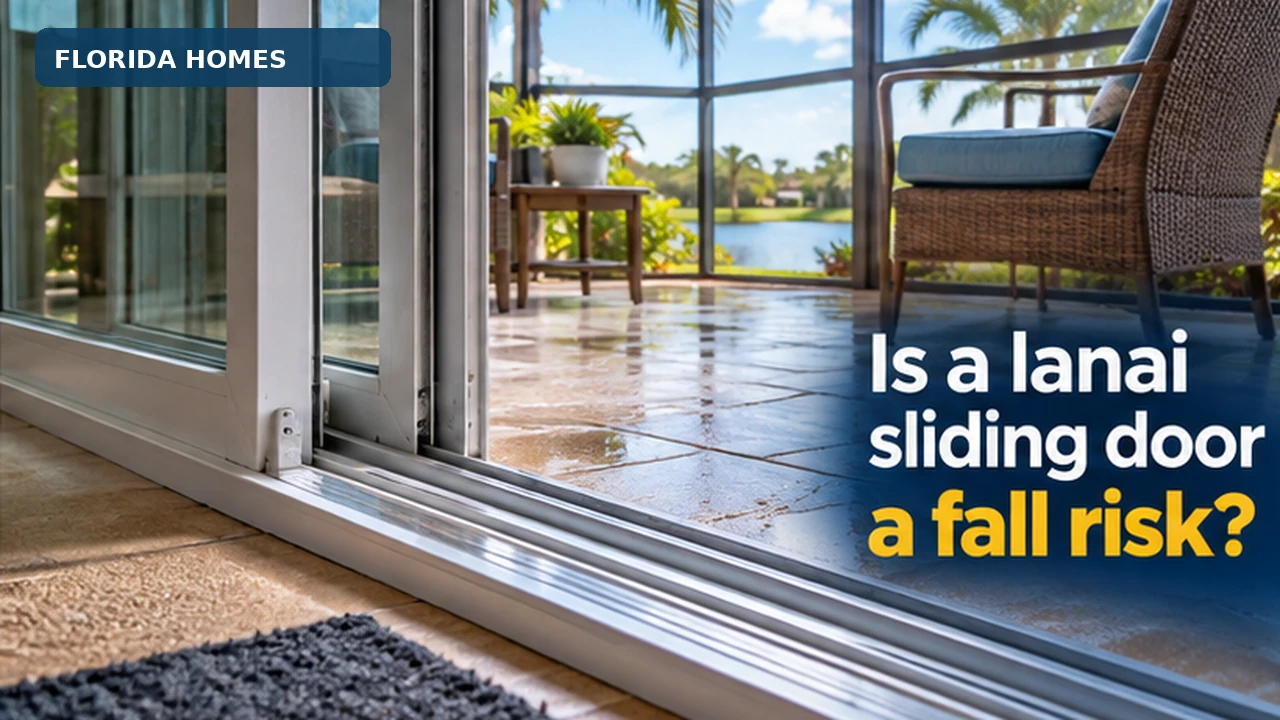
Yes, for many people it is. A Florida lanai slider combines a raised track to step over, a heavy glass panel to push, and often a step down to a floor that can be wet. Each is manageable, but together they can trip a walker user or stop a wheelchair. The good news is that most fixes do not require replacing the door.
Four things to check
1. Track height
Florida sliders are built to keep out wind-driven rain, so many sit on a raised sill. Manufacturers describe typical raised sills as roughly 3/4 inch to 1 1/2 inches tall. Some impact-rated doors approved for Florida use optional sill risers of nearly 3 inches or more, because a taller sill resists more water.
For comparison, the ADA accessibility standards for public buildings allow a door threshold of only 1/2 inch, or 3/4 inch on an existing sliding door if it is beveled. Anything taller behaves like a small step. A walker's front legs or a rollator's wheels can catch on it, and a shuffling foot can too.
2. Door weight and glide
Impact glass is heavy. A panel that sticks, jumps its track or takes a hard shove to start moving is a balance risk. The person has to pull or push while standing sideways, often holding a walker with one hand.
- Clean the track and have the rollers checked or replaced
- Add a large, easy-grip pull handle at a comfortable height
- Practice opening the door while seated if standing balance is poor
3. Clear width
A two-panel slider opens only half its width, minus the frame. Measure the actual opening with the door pushed all the way open. Then compare it to the device the person uses.
| Device | Typical width |
|---|---|
| Standard walker | 22.5 to 28 in |
| Rollator | 23 to 30 in |
| Standard power wheelchair | about 25 in |
| Manual wheelchair | about 27 in |
| Heavy-duty power wheelchair | up to 32 in |
The ADA calls for at least 32 inches of clear opening for a wheelchair. Leave room for hands on the wheels and for bags hanging from a walker.
4. What is on the other side
Many lanais sit a step below the house, and the lanai floor may be wet from rain, a pool or morning dew. Screen doors add a second track. Check for a step you cannot see from inside, a slick surface, poor light at night, and pool edges.
Fixes, from simplest to biggest
- Threshold ramps. Small rubber or aluminum ramps placed on one or both sides of the track turn the lip into a gentle slope. They typically cost about $50 to $500. They must fit the exact height and shape of the track, or they create a new trip edge.
- Lighting and contrast. Light both sides of the door and mark any step down with a contrasting edge strip.
- Non-slip surfaces. Use slip-resistant coatings or outdoor mats with sealed edges on the lanai.
- A grab bar or railing. A vertical grab bar beside the door frame gives a hand hold for stepping over the track.
- Door service or replacement. New rollers can make a heavy door easy to slide. Replacing the door with a lower-sill model is sometimes possible, but it must still meet Florida's wind and water requirements.
Do not remove the sill yourself
The raised sill is part of how the door keeps out water in a storm. In Florida's wind-borne debris regions, glazed openings must be impact resistant or protected. A flush sill shifts the water control job to the slab slope, pan flashing and weep holes. Changing it is a job for a licensed contractor working from the door's approval documents, not a weekend project.
When to get an assessment
If someone uses a walker, rollator or wheelchair, has fallen at the door, or avoids the lanai because it feels unsafe, an assessment can help. We measure the track, the clear width and the device, watch the person use the door, and write specifications a contractor can quote. Start with an Initial Consultation, a 30-minute phone call. Current prices are on our pricing page.
Sources
- U.S. Access Board. Guide to the ADA Standards: entrances, doors and gates
- Florida Building Commission. Product approval FL20838 installation document
- Florida Building Commission. Wind-borne debris reference material
- Gladiator Window and Doors. Flush track sliding door sill explained (manufacturer)
- 1800wheelchair. How wide does a doorway need to be for a wheelchair? (retailer)
- Just Walkers. Walker and rollator widths (retailer)
- Angi. Cost of a wheelchair ramp