
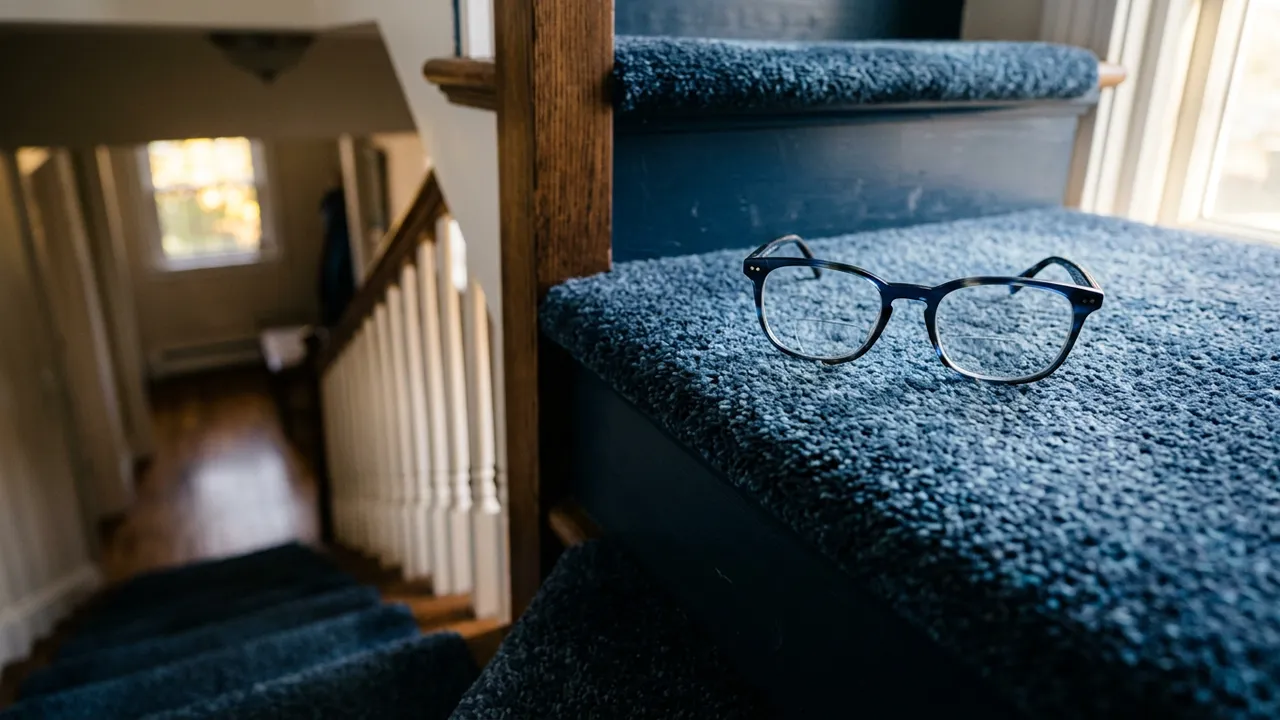
Bifocals and other multifocal lenses can make stairs, curbs and thresholds harder to see, because you look down through the reading part of the lens. For active people who wear multifocals, using single-lens distance glasses for walking outdoors and on stairs has been shown to reduce falls. A second pair of glasses, good lighting and contrasting step edges go a long way.
Why multifocals and stairs do not mix
Bifocals, trifocals and progressive lenses are all multifocal lenses. The top of the lens is set for distance, and the bottom is set for reading.
That works well at a desk. On stairs it works against you. When you look down at a step, you look through the reading part of the lens, so the edge of the step, a curb or a lanai threshold can look blurry. Multifocal lenses are listed among the sensory risk factors for falls in older adults.
Picture a 75-year-old heading down two steps to the driveway while carrying groceries. She glances down through her bifocals, the step edge blurs into the concrete below it, and her foot lands short. It takes only one misjudged step.
What the research found
In a study called the VISIBLE trial, older adults who regularly wore multifocals were given single-lens distance glasses to use when walking outdoors and on stairs. Falls went down among those who routinely took part in outdoor activities.
The key word is "active": the benefit showed up in people who regularly spend time outdoors. Talk with your eye doctor about whether this fits your daily routine.
Practical steps with your glasses
- Ask about a pair of single-lens distance glasses for walking outdoors and on stairs. Keep your multifocals for reading and close work, or use separate reading glasses.
- Keep reading glasses for reading only. Do not walk around in them.
- Get an eye exam every year after age 50, and replace outdated prescriptions.
- Be careful with new glasses. New glasses can briefly raise fall risk. Practice walking outdoors and on stairs with them, with someone nearby at first.
- Tell your eye doctor about any falls or near falls, and about trouble with stairs, curbs or changes in lighting.
- If you need cataract surgery in both eyes, ask about keeping the gap between the first and second surgery short. Fall risk rises in the period between the two operations.
Make the stairs easier to see
Older eyes need about three times as much contrast to see an edge. That makes the stairs themselves just as important as your glasses:
- Mark every step edge with a contrasting strip or contrasting nosing, so the edge stands out from the step below it.
- Watch the last step. When the bottom step is the same color as the floor, it is easy to miss. Mark it clearly.
- Light both ends. Put light switches at the top and the bottom of the stairs, and add motion sensor lights.
- Install rails on both sides for the full length of the stairs.
- Add adhesive treads to slippery steps.
- Keep stairs clear. Nothing should be stored on the steps.
Habits that help
- Carry less, and keep one hand free for the rail.
- Count the steps on stairs you use every day.
- Never rush to answer the phone or the door.
- Pause at the top of the stairs and at doorways to let your eyes adjust, especially moving between bright Florida sun and a dim indoor room.
- Watch for patterned rugs, busy tile and same-colored thresholds that hide edges.
Florida homes have their own "stairs"
Even a home without a staircase can have plenty of steps. Common ones in Tampa Bay homes include the step down to a sunken living room, a lanai threshold, a garage step, and the steps at the front entry. These are easy to miss through the reading part of a bifocal lens. Treat each one like a staircase, with contrast on the edge, good lighting and something sturdy to hold.
For adult children
Signs that a parent's vision may be affecting safety include hesitating at doorways, stairs and changes in lighting, shorter steps, trailing a hand along walls or counters, or closing one eye. Ask when your parent last had an eye exam and how they would describe their vision.
How Home Safety Solutions can help
During a home safety visit we look at every step, threshold and entry you use, along with the lighting and contrast around them. We note vision concerns in your report and recommend follow-up with your eye doctor when something points that way. Learn what happens during a home safety visit. Call (813) 365-9171 or email info@homesafety.solutions.
Related reading: Is a lanai sliding door a fall risk? · How do I make a sunken living room safe for a walker? · CDC Check for Safety home checklist (PDF) · Is it normal to fall as you get older?
This article is general education, not medical advice. Talk with your doctor, pharmacist, or therapist about your own situation.