
Low vision means vision loss that glasses cannot fully correct, and it roughly doubles the chance of a fall. The good news is that lighting, contrast and organization can make a home much safer, often with simple changes. Apps, services and Florida's Division of Blind Services can help with the rest.
Why low vision and falls go together
About 1 in 6 Americans over 70 live with low vision. Aging eyes need roughly three times as much contrast to pick out an object, so lighting and contrast matter as much as the eyeglass prescription.
The three most common causes affect safety in different ways:
- Macular degeneration takes central vision. Reading labels, medicine bottles and faces gets hard.
- Glaucoma takes side vision. Doorframes, pets and steps off to the side are easy to miss.
- Diabetic retinopathy causes patchy blind spots, poor night vision and sensitivity to glare. Night bathroom trips and moving between light and dark are especially risky.
Signs a parent's vision may be worse than they say
Watch for many eye drop bottles, a hand trailing along walls or counters, shorter steps, closing one eye, hesitating at doorways, stairs and changes in lighting, and trouble with paperwork. That last one is sometimes mistaken for memory problems. Ask when the last eye exam was and how your parent would describe their vision.
Light it well
- Layer the lighting and make it adjustable, room by room.
- Place task lamps below eye level and behind the shoulder, so light falls on the task, not in the eyes.
- Add motion sensor night lights from the bed to the bathroom.
- Light dark cabinets and closets.
- Carry a portable clip light for outings.
- Try different bulbs. Warm, cool and natural white light look different to each person, so test a few.
Tame the glare
Glare can be uncomfortable, disabling or even blinding. For someone with low vision, the moment a bright bathroom light flicks on at night can last much longer than it does for others.
- Use sheer curtains to soften bright Florida sun through windows and sliding doors.
- Choose matte surfaces over shiny ones.
- Put lights on dimmers.
- Ask an eye care professional about tinted filter glasses.
Add contrast where it counts
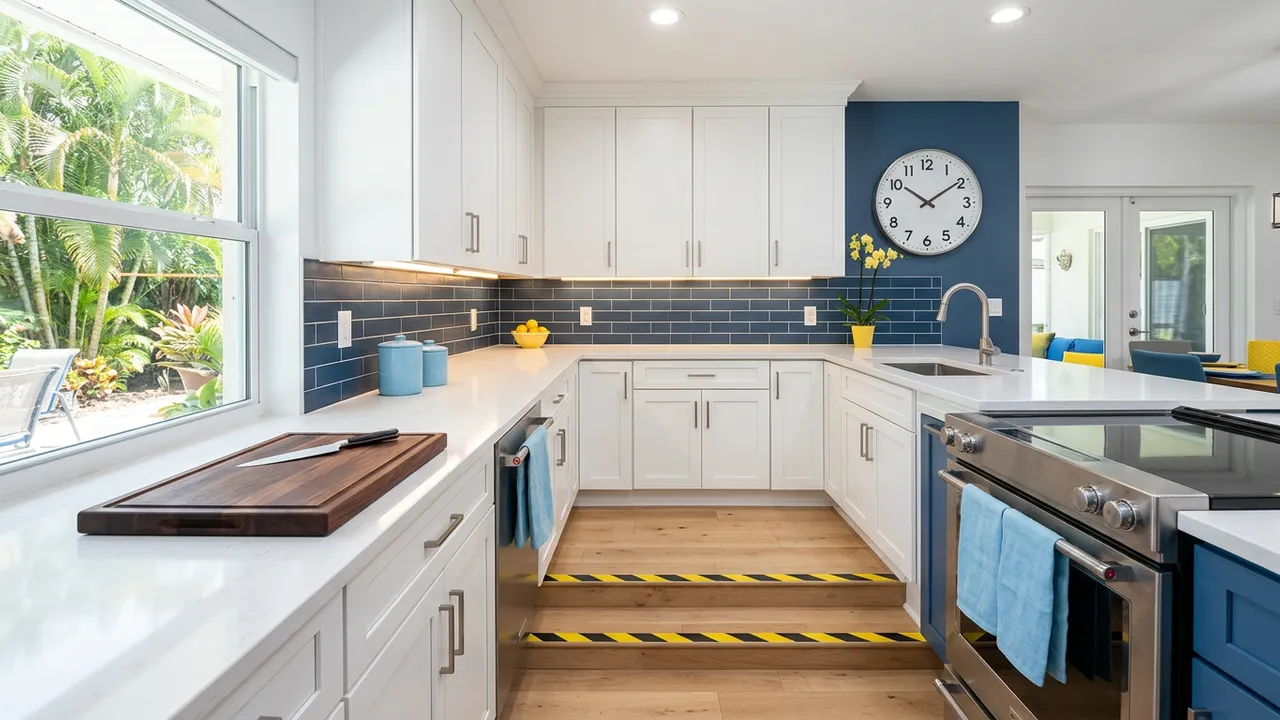
- A contrasting strip on the edge of every step
- A toilet seat and grab bars that stand out from the wall
- Dark placemats under white plates
- A clear color change between floor and wall at doorways
Busy patterned carpet and tile hide edges and dropped items. Solid surfaces are safer, which is worth remembering when choosing new flooring.
Keep everything in its place
Give everything a fixed home. Face labels forward, and keep frequently used items between hip and shoulder height. Ask family and visitors to put things back exactly where they found them.
Simple tools, low-tech and high-tech
- Marking items: bump dots, puff paint or rubber bands on dials, bottles and appliances
- Reading and writing: bold-line paper, felt-tip pens, signature guides, large-print checks, and lighted handheld or stand magnifiers
- Medicines: a large-print planner, an eye drop guide and a contrasting tray for pills
- Health devices: talking blood pressure cuffs, scales, thermometers and glucometers
- Kitchen: a liquid level indicator, cutting guides and a talking thermometer
- Phone and home: larger text, zoom, color invert and VoiceOver on the phone, high-contrast keyboard stickers, and smart speakers to control lights, locks and thermostat by voice
A safety caution: head-worn magnifying devices distort depth perception. Never walk while wearing one.
Apps and services
- Be My Eyes and Seeing AI are smartphone apps that use your phone's camera to help with everyday seeing tasks.
- ScripTalk talking prescription labels are free through participating pharmacies. Call 1-800-890-1180 or search the pharmacy list.
- Hadley helps adults who are living with vision loss. Call 1-800-323-4238.
- The National Library Service for the Blind and Print Disabled can be reached at 800-424-8567.
Apps are optional helpers. They never replace a person checking in or a plan for what happens after a fall.
Florida resources
The Florida Division of Blind Services provides state vision rehabilitation services and may help with device costs. Its Tampa district office can be reached at 800-757-7190. FAAST (Florida Alliance for Assistive Services and Technology) offers assistive technology loan and reuse programs: 844-353-2278.
If someone needs more magnification than simple aids provide, ask their eye doctor for a referral to a low vision specialist.
How Home Safety Solutions can help
Home modification by a trained clinician helps prevent falls in people with severe vision loss. During a home safety visit we check lighting, glare, contrast, patterns and organization along the routes you actually use, and we recommend follow-up with your eye doctor when something points that way. Learn what happens during a home safety visit. Call (813) 365-9171 or email info@homesafety.solutions.
Related reading: Hadley · Be My Eyes app · Seeing AI app · ScripTalk participating pharmacies · Is it normal to fall as you get older?
This article is general education, not medical advice. Talk with your doctor, pharmacist, or therapist about your own situation.