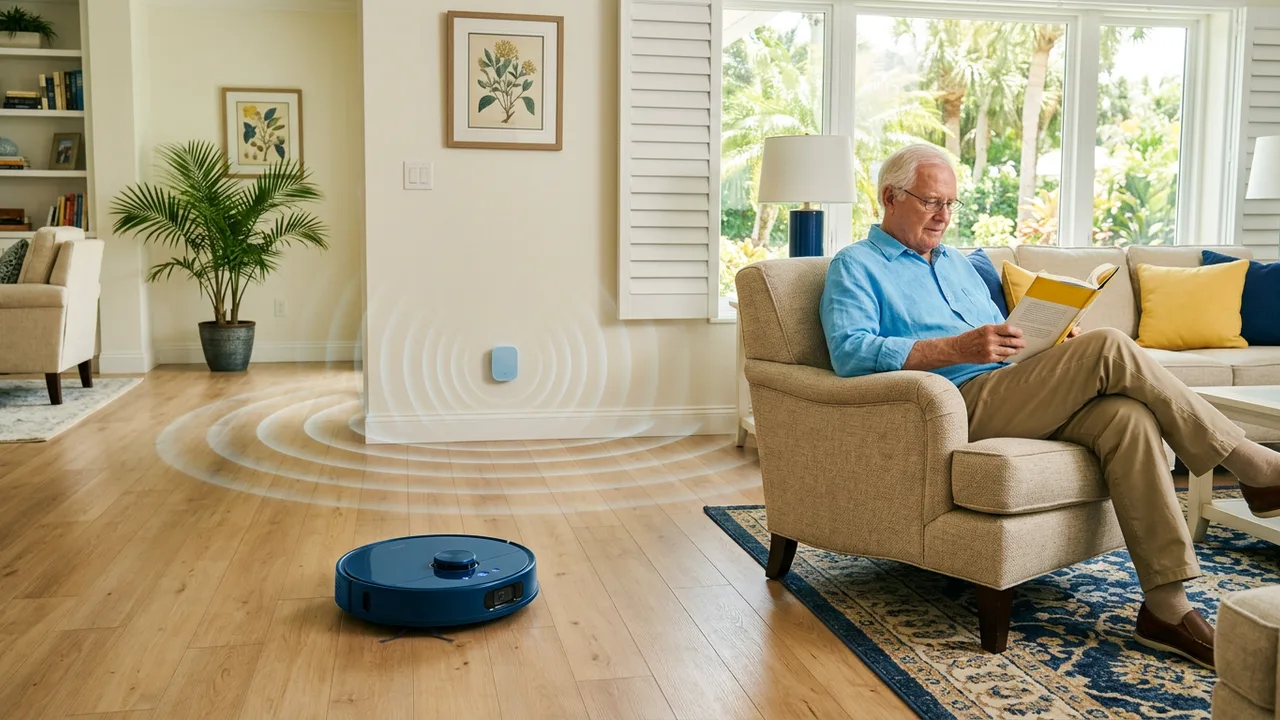
Yes, a robot vacuum can help find someone who has fallen, and at least one major brand already sells this feature. But a vacuum is a responder, not a lookout. It works best as one piece of a larger fall detection plan, not as the whole plan.
Why finding someone fast matters
Falls in older adults are common, and the toll keeps rising. Over the past ten years, fall deaths among older adults rose 51%. In 2024, 43,020 adults age 65 and older died from falls in the United States. More than 3.85 million were treated in emergency departments for fall injuries in 2023.
The fall is only half the danger. In one study of people over 90, 80% of those who fell could not get up after at least one fall, and 30% lay on the floor for an hour or more. Those long lies were strongly linked to hospital stays, serious injury, and moves into long-term care.
So the real question is not only "Can we detect a fall?" It is "How fast can we find the person, see what happened, and get help there?" That is where a robot that already drives around the floor every day starts to look interesting.
What a robot vacuum can and can't do
Many newer robot vacuums carry the same tools a fall detection system needs: a laser scanner (LiDAR) to map the house, a front camera, and built-in AI that recognizes objects like socks, cords and pet messes. Recognizing a person lying on the floor is mainly a software step.
Researchers have already shown it works. In a 2024 study, a small home robot built from vacuum-style parts recognized people who had fallen with 96% accuracy. It looks for a person on the floor instead of trying to catch the fall as it happens. That is exactly the job a roaming robot is suited for.
Here is the catch. A robot vacuum sees the world from about 4 inches off the floor, runs on a schedule, and spends most of the day parked on its dock. It cannot climb stairs, and it cannot get into a bathroom with the door closed. On its own, it will miss many falls.
The first product you can buy
Samsung is the first major brand to sell this. Its SmartThings Family Care service includes a feature called Safety Patrol:
- If the home's connected devices show no activity for a set period, a family caregiver gets an alert.
- The caregiver can send a camera-equipped Samsung Jet Bot robot vacuum to look around.
- If the camera finds a person, standing or on the floor, a two-way voice call opens so the caregiver can talk with them.
Samsung is honest about the limits. The system does not have a true fall sensor, and it cannot tell a fall from a nap. Samsung itself recommends a fall detection watch or pendant for catching the fall the moment it happens. The person being monitored must agree to it, and the caregiver must be given remote control permission ahead of time.
The other tools in the toolbox
No single sensor does it all. Each one covers a gap the others leave.
| Tool | How it works | Strengths | Limits |
|---|---|---|---|
| Watch or pendant | Senses a hard impact, then stillness | Works anywhere, can call 911 on its own | Only works if worn and charged; can miss slow slides and chair falls |
| Radar sensor | Radio waves track body position, even breathing | No camera image; works in the dark and in a steamy bathroom | Covers one room per sensor |
| Camera with AI | Software recognizes a fall | Most accurate; staff can see what happened | Privacy concerns in bedrooms and bathrooms |
| Thermal sensor | A blurry heat picture shows a body shape | No identifiable image | Mostly sold to senior living communities |
| Wi-Fi sensing | Changes in the home's Wi-Fi signals reveal movement | Uses the router you already have | Fall detection is still being proven |
| Listening device | AI listens for a fall or a call for help | Covers places cameras can't | Sound only; noisy homes are harder |
| Robot vacuum | Camera finds a person on the floor | Moves to the person; adds a two-way call | Not always running; can't do stairs |
Radar is the fastest-growing choice for homes because it needs no camera and works in any light. Cherish Health is one company leading here: its radar sensors monitor several rooms and several people at once, detect emergencies such as falls, and, through a partnership with Alarm.com, send alerts to family or professional monitoring. Nothing has to be worn, charged, or pressed. Researchers point out that most radar studies still use staged falls, and cutting false alarms is the big challenge.
Cameras have the strongest real-world results. In six California memory care communities, real-time video alerts cut the average time on the floor by about 30 minutes. The share of residents left on the floor for over an hour dropped from 31% to zero.
Wi-Fi sensing is the newcomer. A new Wi-Fi standard now includes sensing, and fall detection is one of its intended uses. I covered this in more depth in I've fallen and I can't get up.
The dream: catching fall risk before the fall
The ideal setup is a team of devices that work together:
- Sensors in the rooms (radar or Wi-Fi) watch for a fall, a long stillness, or a missed morning routine, without cameras.
- A watch or pendant covers the person outside those rooms: the garage, the yard, the grocery store.
- A robot checks in. When a sensor raises a flag, a robot drives to the person, confirms what happened, and opens a video call. This cuts false alarms and tells the family whether to call 911 or just come help.
- Smart software watches the trends, not just the emergencies.
That last part is the real prize. Detecting a fall shortens the wait on the floor. Predicting a fall can prevent it.
As a physical therapist, I pay close attention to walking speed. Research shows it is one of the most useful single signs of fall risk, though no one test is enough on its own. Phones already measure walking speed and step length in the background. Radar can measure walking in a hallway. A robot vacuum's laser scanner can time how fast someone walks past it.
Put those together and the system could say: "Mom's walking speed in the hallway has dropped over three weeks, she is getting up at night twice as often, and her bathroom trips take longer." That is a reason to schedule a therapy evaluation, a medication review, or a doctor visit before the fall, not after.
We are not there yet. Most of these tools are sold separately and don't talk to each other, and outside researchers have asked companies to share more data on how well their fall risk scores work.
What you can use today
Start with the basics:
- A watch or pendant that calls for help on its own. Apple Watch turns on fall detection automatically for people 55 and older. If a person stays still for about a minute after a hard fall, it counts down and then calls 911 and texts emergency contacts. Google's Pixel Watch works in a similar way. If a watch isn't a good fit, a medical alert pendant with automatic fall detection is the next choice. Practice pressing the button anyway, because no device catches every fall.
Then cover the risky rooms:
- A radar sensor in the bathroom and bedroom, where watches and pendants often come off. Cherish Health offers a whole-home radar hub built for aging in place. Check whether the product is a medical device, who gets the alert, and how it sends it. Some products were built around services that have since been shut down.
- Lights that come on when someone gets up at night. This one prevents falls rather than detecting them.
Then add a way to check in:
- A camera-equipped robot vacuum such as Samsung's Jet Bot, if your family already uses Samsung SmartThings and your loved one agrees to it.
And always:
- Confirm who gets each alert and that they will answer at 3 a.m.
- Put a key safe or smart lock by the door so help can get in.
- Test every device with a pretend fall.
- Set a daily charging routine for any wearable.
- Get a fall risk check from a physical therapist. Try the three 5-minute tests to check your fall risk at home to start.
Privacy and dignity come first
The best system is the one your loved one agrees to. Monitoring that feels like spying gets unplugged or left in a drawer.
- Ask first, and ask again if memory or health changes.
- Use camera-free sensors in bedrooms and bathrooms. Save cameras, including robot cameras, for checking in after an alert.
- Ask where the data goes. Processing on the device or home hub is more private than sending video to the cloud.
- Choose products that work with more than one system, so a company shutting down a service doesn't leave your parent unprotected.
For more on getting this balance right, read Video cameras for Mom & Dad.
Technology is a helper, not a caregiver. Sensors shorten the wait on the floor and flag rising risk. People still provide the strength and balance training, medication reviews, home changes, and connection that actually prevent falls.
Home Safety Solutions does not accept referral fees from any vendor, so our suggestions stay unbiased.
How Home Safety Solutions can help
A home safety visit looks at where falls are most likely in your home and builds a plan for what happens if one does: which devices fit your loved one's routines, where sensors should go, whether they can get up from the floor, and how help gets in. Our Remote Caregiving Plan goes deeper on monitoring technology for families who live far away. Call (813) 365-9171 or email info@homesafety.solutions.
Related reading: Medical alert devices and fall detection: what to know · I've fallen and I can't get up · How can I check on a parent's safety from another state? · Video cameras for Mom & Dad · Three 5-minute tests to check your fall risk at home
This article is general education, not medical advice. Talk with your doctor, pharmacist, or therapist about your own situation.
Sources
- National Safety Council. Older Adult Falls. Injury Facts.
- Fleming J, Brayne C. Inability to get up after falling, subsequent time on floor, and summoning help: prospective cohort study in people over 90. BMJ. 2008;337:a2227.
- Elwaly A, Abdellatif A, El-Shaer Y. New Eldercare Robot with Path-Planning and Fall-Detection Capabilities. Applied Sciences. 2024;14(6):2374.
- SmartThings. SmartThings Family Care: Care on Call and Safety Patrol. October 20, 2026.
- The Next Web. Samsung SmartThings update adds elderly care monitoring with ambient sensing and AI. April 16, 2026.
- Hu S, Cao S, Toosizadeh N, et al. A Survey on Radar-Based Fall Detection. arXiv preprint. 2023.
- Bayen E, Nickels S, Xiong G, et al. Reduction of Time on the Ground Related to Real-Time Video Detection of Falls in Memory Care Facilities: Observational Study. J Med Internet Res. 2021;23(6):e17551.
- Du R, Xie H, Hu M, et al. An Overview on IEEE 802.11bf: WLAN Sensing. arXiv preprint. 2022.
- Beck Jepsen D, Robinson K, Ogliari G, et al. Predicting falls in older adults: an umbrella review of instruments assessing gait, balance, and functional mobility. BMC Geriatrics. 2022;22:615.
- Brell M, Frenken T, Meyer J, Hein A. A Mobile Robot for Self-selected Gait Velocity Assessments in Assistive Environments. PETRA 2010.
- Apple. Measuring Walking Quality Through iPhone Mobility Metrics. May 2021.
- STAT. Apple walking steadiness research. July 15, 2021.
- Apple. Use Fall Detection with Apple Watch.
- Google. Google Pixel Watch can now detect when you fall. February 28, 2023.
- MIT News. Butlr creates smart buildings with privacy-first sensors. February 11, 2025.
- Cherish Health. Radar-based home monitoring.
- Maginative. Sensi.AI Secures $31M to Expand AI-Powered Home Care. June 26, 2024.