
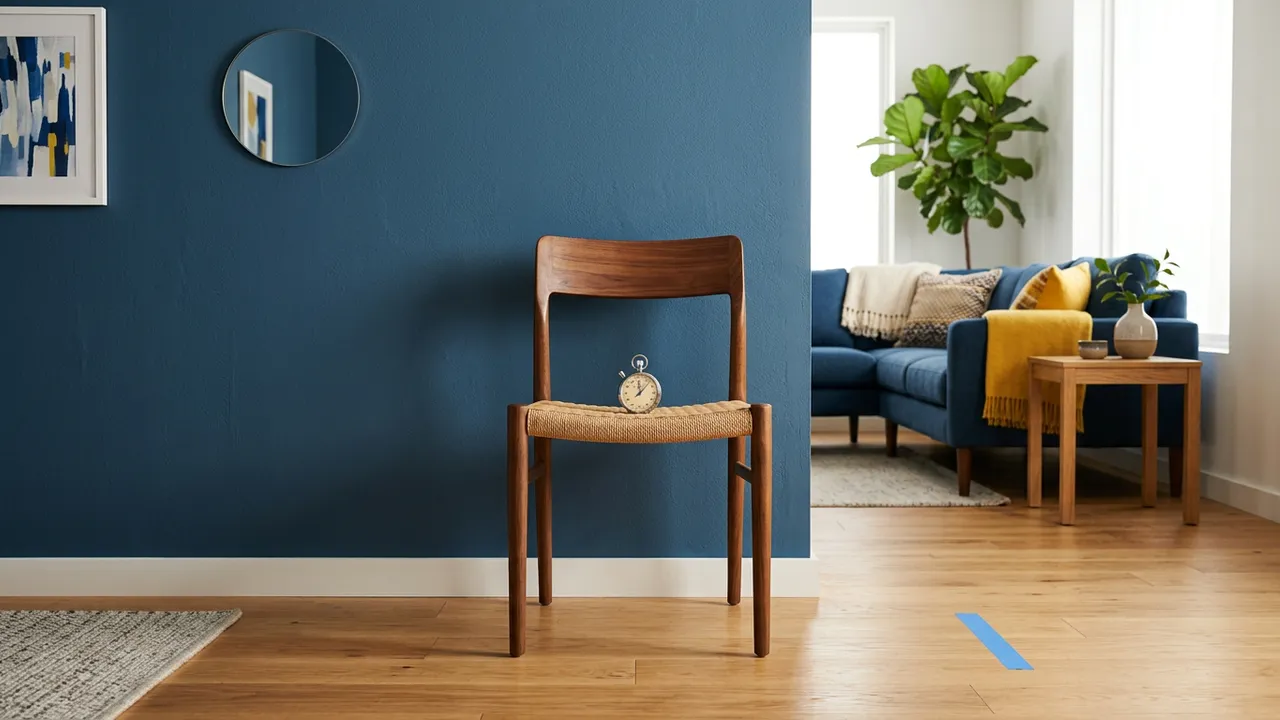
Three short tests used by doctors and therapists can give you a quick picture of your strength and balance: the 30-Second Chair Stand, the 4-Stage Balance Test and the Timed Up and Go. You can try them at home in about five minutes each, as long as a helper stands beside you. They do not diagnose anything, but a low score is a good reason to talk with your doctor or a physical therapist.
Before you start: safety first
These tests are meant to be a little challenging, so set up carefully:
- Have a helper stand close beside you, ready to steady you. Do not test alone.
- Use a sturdy chair with a straight back, about 17 inches high, pushed against a wall so it cannot slide.
- Stand near a kitchen counter or other solid surface you can grab.
- Wear your usual shoes, not socks or slippers, on a dry, non-slip floor. Skip slick tile if you can.
- Use your usual cane or walker for the walking test if you normally use one.
- Stop right away if you feel dizzy, short of breath or have pain.
If you have fallen recently, feel very unsteady or have been told not to stand without help, skip the home version and ask your doctor or physical therapist to do these tests with you.
Test 1: 30-Second Chair Stand (leg strength)
This test shows how strong your legs are, one of the biggest fall risks you can change.
- Sit in the middle of the chair with your feet flat on the floor.
- Cross your arms over your chest.
- When your helper says "go," stand all the way up, then sit all the way back down.
- Repeat as many times as you can in 30 seconds while your helper counts.
If you have to push with your hands to stand, stop. Your score counts as zero.
Scores below these numbers are below average for your age:
| Age | Men | Women |
|---|---|---|
| 65 to 69 | 12 | 11 |
| 70 to 74 | 12 | 10 |
| 75 to 79 | 11 | 10 |
| 80 to 84 | 10 | 9 |
| 85 to 89 | 8 | 8 |
| 90 to 94 | 7 | 4 |
Test 2: 4-Stage Balance Test (standing balance)
This test checks how well you hold still as your stance gets narrower. Your helper stands beside you, and you may hold the counter to get into each position, then let go. Try to hold each position for 10 seconds without moving your feet or grabbing support.
- Feet together, side by side.
- Semi-tandem: move one foot about half a step forward, with the feet still touching.
- Tandem: place one foot directly in front of the other, heel touching toe.
- One leg: stand on one foot.
For the official instructions, see the CDC test sheet linked at the end of this article.
Only move to the next stage if you held the last one for 10 seconds. If you cannot hold the tandem stance for 10 seconds, you are at increased risk of falling.
Test 3: Timed Up and Go (walking and turning)
This test checks how you get up, walk and turn.
- Mark a spot on the floor 10 feet in front of the chair with tape.
- Sit with your back against the chair.
- When your helper says "go" and starts a timer, stand up, walk at your normal pace to the tape, turn around, walk back and sit down.
- Your helper walks alongside you the whole time and stops the timer when you are seated.
Taking 12 seconds or more means you are at increased risk of falling. Your helper should also watch how you walk: short or shuffling steps, losing balance on the turn, reaching for furniture or walls, or a lot of sway are all worth mentioning to your doctor.
What your results mean
If any test shows you at risk, you are not alone, and there is a lot you can do. Exercise that challenges balance is the single most effective way to prevent falls. A physical therapist can build a program that fits you, and your doctor can look for other causes, such as medicines or blood pressure drops.
Write down your scores and the date, and bring them to your next appointment. You can repeat the tests later to see whether your exercise program is helping.
If your scores look fine, keep it that way. Stay active, and still ask your doctor about falls once a year. Strong test scores do not rule out risks from medicines, vision or the home.
How Home Safety Solutions can help
Our home safety visits use these same standard tests, so findings can be shared with your physician in familiar terms. Then we look at how you move through your own home: your bed, chairs, toilet, steps and the night route to the bathroom. Learn what happens during a home safety visit. Call (813) 365-9171 or email info@homesafety.solutions.
Related reading: CDC 30-Second Chair Stand (PDF) · CDC 4-Stage Balance Test (PDF) · CDC Timed Up and Go (PDF) · CDC Chair Rise Exercise (PDF) · Is it normal to fall as you get older?
This article is general education, not medical advice. Talk with your doctor, pharmacist, or therapist about your own situation.