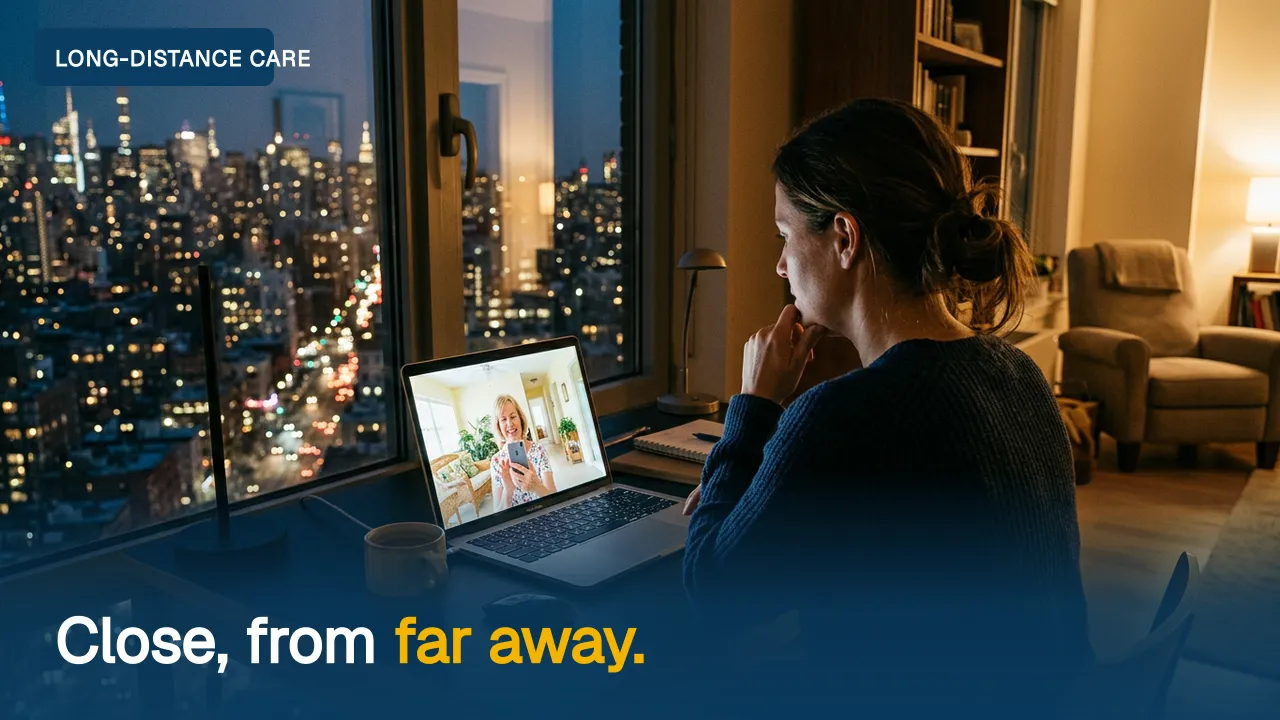
Combine three things: regular video visits where you actually look at the house, a small amount of technology your parent agrees to, and a local team you can call. No sensor replaces a neighbor with a key. But the right mix can tell you early when something is changing, and get help there fast when something goes wrong.
You are not alone
AARP estimates that 63 million Americans are family caregivers, up nearly 50 percent since 2015. More than 1 in 10 live an hour or more away from the person they care for. The share of caregivers using remote monitoring rose from 13 percent in 2020 to 25 percent in 2025.
1. Make video visits work harder
A regular video call can be a quick safety check if you know what to look for. Ask your parent to walk you around with the phone once a month.
- Kitchen: fresh food in the refrigerator, expired items, burned pots, and whether the stove is used
- Bathroom: a bath mat that slides, towel bars used as handholds, and signs that bathing has stopped
- Paths: new clutter, cords or throw rugs, and furniture your parent grabs while walking
- Mail and pills: unopened bills and medications that are not going down as they should
- Your parent: new bruises, weight change, shuffling, holding the walls, or changes in mood or memory
If you see changes between visits, that is the time to act, not after a fall.
2. Choose technology with your parent, not for them
| Tool | What it does well | Limits |
|---|---|---|
| Medical alert pendant or watch | Lets your parent call for help with one button; some detect falls | Only works if worn, including in the shower and at night |
| Automatic fall detection | Can call for help when your parent cannot | Accuracy varies; real-world testing in frail older adults is limited |
| Motion and door sensors | Show routine without cameras: up in the morning, fridge opened, front door used | Show that something changed, not what happened |
| Smart speakers and video doorbells | Voice calling, reminders, seeing who comes to the door | Need Wi-Fi and some setup |
| Medication dispensers | Timed reminders and alerts for missed doses | Need someone to refill them |
A review of fall detection studies found high accuracy in some lab settings, but most of the underlying reviews were low quality. Treat fall detection as a backup, not a guarantee.
Privacy matters. In one study, adult children were far more comfortable with cameras in their mother's home than the mothers were. Seven of 10 children accepted cameras, but only 1 of 10 mothers did. Start with what your parent is comfortable with, and explain what you will and will not see.
3. Build a local team
Write down who can be at the house within an hour. Share the list with everyone on it.
- A neighbor or friend with a key
- The primary doctor and pharmacy
- A local home care agency, if paid help is in place
- The Area Agency on Aging, for services and benefits
- A geriatric care manager, if you need a professional to coordinate care. Care managers typically charge $75 to $300 an hour.
| Resource | Phone |
|---|---|
| Eldercare Locator (national) | 1-800-677-1116 |
| Florida Elder Helpline | 1-800-963-5337 |
| Senior Connection Center (Hillsborough, Manatee and nearby counties) | 813-740-3888 |
| Area Agency on Aging of Pasco-Pinellas (from outside the area) | 727-217-8111 |
The Aging Life Care Association has a directory of geriatric care managers.
How we help from a distance
If your parent lives in the Tampa Bay area, we can do the home visit in person while you join by phone or video. Virtual visits are available for homes in Florida, Ohio and New York. We send the photo report to you with your parent's signed permission. Our Remote Caregiving Plan, added to a home assessment, lays out the devices, settings and local contacts that fit your parent, for qualified installers to set up. Start with an Initial Consultation, a 30-minute phone call. Current prices are on our pricing page.
Sources
- National Institute on Aging. What is long-distance caregiving?
- AARP. Caregiving in the U.S. 2025
- AARP. Long-distance caregiving
- Umbrella review of fall detection systems. PMC8591794
- Berridge C, Wetle TF. (2020). Why older adults and their children disagree about in-home surveillance technology. The Gerontologist.
- U.S. Administration for Community Living. Eldercare Locator
- Florida Department of Elder Affairs. Elder Helpline
- Senior Connection Center
- Area Agency on Aging of Pasco-Pinellas
- Aging Life Care Association