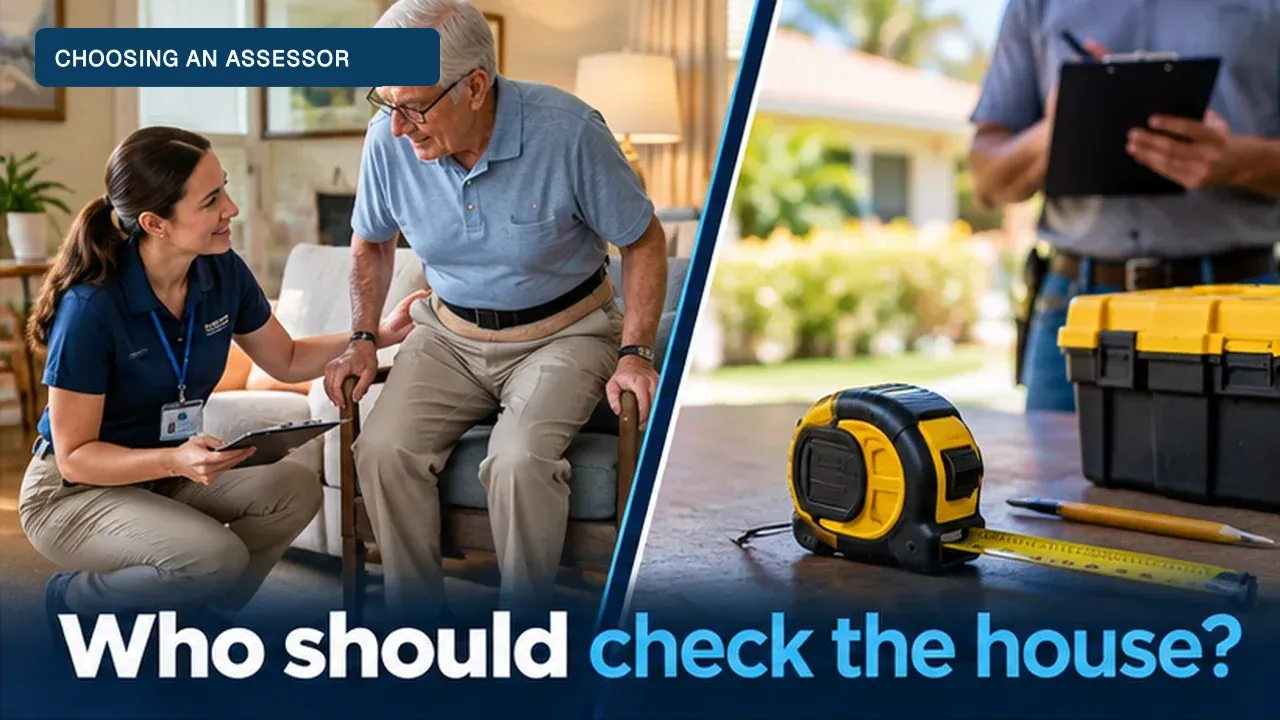
Many people offer home safety assessments: contractors, franchise companies, care agencies and therapists. For someone who has fallen or has trouble moving around, a licensed physical therapist or occupational therapist is usually the right person. They assess the person and the home together, which is what reduces falls.
The difference: checking the house vs. matching the house to the person
A hazard checklist looks at the house. Is there a throw rug? Are the stairs lit? Is there a grab bar? That is useful, but it misses half the problem.
The same bathroom can be safe for one person and dangerous for another. It depends on their balance, strength, vision, memory, and how they get on and off the toilet. A clinician watches the person move through their own home and matches the changes to what that person can actually do.
The research supports this. In a randomized trial of 238 adults age 70 and older who had fallen, home assessments by occupational therapists cut falls by 46 percent over a year. Assessments by trained assessors who were not therapists had no significant effect (Pighills et al., 2011).
Who does what
| Provider | What they bring | What to watch for |
|---|---|---|
| Occupational therapist (OT) | Daily tasks such as bathing, toileting, dressing and cooking; equipment training; home modification recommendations | Availability; many work only inside home health or hospital systems |
| Physical therapist (PT) | Balance, strength, walking, transfers and fall risk testing; home safety recommendations | Same; home visits are often tied to a Medicare home health episode |
| RESNA Assistive Technology Professional (ATP) | Nationally accredited credential in matching assistive technology to the person, from walkers to power chairs to smart home devices | Holders vary in background; ask about clinical training |
| Certified Aging-in-Place Specialist (CAPS) | NAHB training in aging-in-place design for the remodeling market, usually held by builders and remodelers | Not a clinical credential; many CAPS holders also sell the work |
| Senior home safety certificate holders | Short online courses covering common hazards | No clinical license required |
| Contractors and franchise "free checks" | Knowledge of construction, cost and permits | They often sell what they recommend (see our article on free checks) |
Occupational therapists and physical therapists overlap in home safety, and each sees risk the other might miss. OTs tend to focus on how a person completes daily tasks. PTs tend to focus on balance, gait and getting up and down. Both are trained to run standardized fall risk tests, such as the CDC's STEADI tools.
Where contractors fit
Good contractors are essential. They build the ramp, install the grab bars and pull the permits. The American Occupational Therapy Association describes the best home modification teams as clinicians who assess and recommend, working alongside builders who do the construction.
The problem arises when the same company assesses the home and then sells the fix. That is not always bad, but it is a conflict of interest you should know about.
Questions to ask any assessor
- Are you a licensed clinician? In what profession and state?
- What credential do you hold, and what did it take to earn it?
- Will you watch the person move through the home, or only look at the house?
- Do you use a standardized fall risk test or home assessment tool?
- Do you sell or install anything? Do you accept referral fees from contractors?
- Will I get a written, itemized report that any contractor can price?
How we work
Home Safety Solutions assessments are done by Russ L'HommeDieu, DPT, ATP, a physical therapist with more than 35 years of experience. He served as a home safety coordinator with the VA, holds the RESNA ATP credential, and is trained in aging-in-place design and modification through the National Association of Home Builders. We assess and recommend. You choose and pay your own contractor, and we accept no referral fees or payments from contractors. Start with an Initial Consultation, a 30-minute phone call. Current prices are on our pricing page.
Sources
- American Occupational Therapy Association. Home modifications: key community partnerships
- American Physical Therapy Association, ChoosePT. Physical therapy guide to falls
- RESNA. Assistive Technology Professional (ATP)
- National Association of Home Builders. Certified Aging-in-Place Specialist (CAPS)
- Age Safe America. Senior Home Safety Specialist
- Centers for Disease Control and Prevention. STEADI clinical resources
- Pighills AC, et al. (2011). Environmental assessment and modification to prevent falls in older people. Journal of the American Geriatrics Society, 59(1), 26 to 33. (Via PubMed.)