
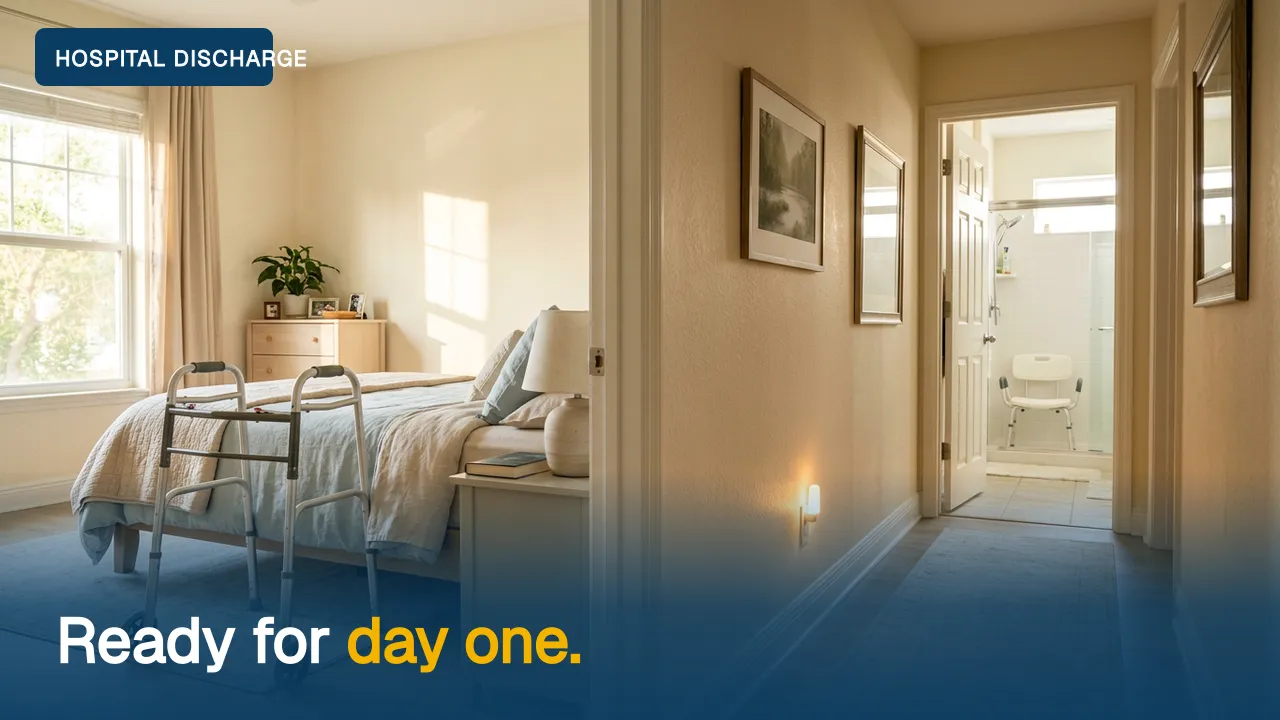
Before someone comes home from the hospital, four places need to work on day one: the bathroom, the bed, the path between them, and the way in the front door. Almost everything else can wait a week. The first two weeks home are when falls are most likely, so this short list matters more than a full renovation.
Why the first two weeks matter
One well-known study followed adults 65 and older after a hospital stay for a medical illness. They fell at a rate of 8.0 falls per 1,000 days in the first two weeks home. Three months later, the rate had dropped to 1.7. Fall injuries accounted for 15 percent of all hospitalizations in the first month (Mahoney et al., 2000).
Risk was higher for people who used a standard walker, showed signs of delirium after discharge, or had poorer balance. That describes many patients leaving a hospital or rehab center today.
The hospital has a job here too. Federal rules require hospitals to plan discharges with the patient and family as active partners. They must also check whether the services the patient will need are actually available at home. But no one on the discharge team is required to walk through the house.
The four areas to have ready
1. The bathroom
Most bathroom injuries happen at the tub or shower, followed by the toilet. Before discharge, the person needs a safe way to get on and off the toilet and a plan for bathing.
- A raised toilet seat or toilet safety frame if the toilet is low
- A shower chair or tub transfer bench, sized to the tub or shower
- Grab bars anchored into studs or blocking, not towel bars or suction cups
- A non-slip mat or strips inside the tub and a dry, non-slip mat outside it
- A handheld shower head, so bathing can happen seated
If grab bars cannot be installed in time, plan sponge baths for the first few days rather than risking a shower.
2. The bed
The bed should let feet rest flat on the floor with knees at about a right angle when seated at the edge. Many bedroom safety guides suggest a bed height of roughly 20 to 23 inches, but the right height depends on the person's leg length and strength.
- A lamp or light switch reachable from bed
- Phone, glasses and water on a stable nightstand
- A bedside commode if the bathroom is far or the person is weak at night
- A first-floor bedroom if stairs are not yet safe
3. The path
Walk the route from bed to bathroom to kitchen to chair, holding an imaginary walker. A standard walker is about 22 to 28 inches wide, so the path needs to be at least that clear.
- Remove throw rugs, cords and floor clutter
- Rearrange furniture so the walker fits through without turning sideways
- Add night lights or motion-sensor lights along the route
- Put a sturdy chair with armrests in the main living area
4. The entry
The person has to get from the car into the house. Count the steps at the door you will actually use.
- Railings on at least one side of entry steps, ideally both
- A plan for any step without a railing, such as a helper standing by
- A threshold ramp if a raised door sill will catch the walker
- An entry that is lit if arrival will be after dark
What can wait
Some projects feel urgent but can safely follow in the weeks after discharge. These include a walk-in shower conversion, widening doors, a permanent ramp, kitchen changes, and stair lifts. Make the home safe for the first two weeks, then plan larger changes once you know how the person is really doing at home.
Who checks it
In most cases, no one does. Home health therapists may visit after discharge, but often after the first few days. Friends and contractors can install equipment, but they are not trained to match the house to the person's balance, strength and walking.
A physical or occupational therapist can do that match. A large 2023 Cochrane review found that home hazard changes reduced falls by 26 percent overall. For people at higher risk of falling, the reduction was 38 percent. A small trial after hip fracture found fewer readmissions when an occupational therapist visited the home before discharge (Lockwood et al., 2019).
The key is to target the people who need it most: those leaving the hospital with a new walker, a recent fall, weakness or confusion.
How we help
Our Ready for Discharge assessment is designed for exactly this moment. It can be done by phone and video with family walking the house, or in person in the Tampa Bay area. You receive a prioritized list of what must be done before the patient comes home and what can wait. Every service starts with an Initial Consultation, a 30-minute phone call. Current prices are on our pricing page.
Sources
- Centers for Medicare & Medicaid Services. Condition of participation: Discharge planning, 42 CFR 482.43
- Clemson L, et al. (2023). Environmental interventions for preventing falls in older people living in the community. Cochrane Database of Systematic Reviews.
- Centers for Disease Control and Prevention. MMWR: Nonfatal bathroom injuries among persons aged 15 and older
- National Council on Aging. Bedroom safety guide
- Just Walkers. Walker and rollator widths
- Mahoney JE, et al. (2000). Temporal association between hospitalization and rate of falls after discharge. Archives of Internal Medicine, 160(18), 2788 to 2795. (Via PubMed.)
- Lockwood KJ, et al. (2019). Predischarge home visits after hip fracture: a randomized controlled trial. Clinical Rehabilitation, 33(4), 681 to 692. (Via PubMed.)