
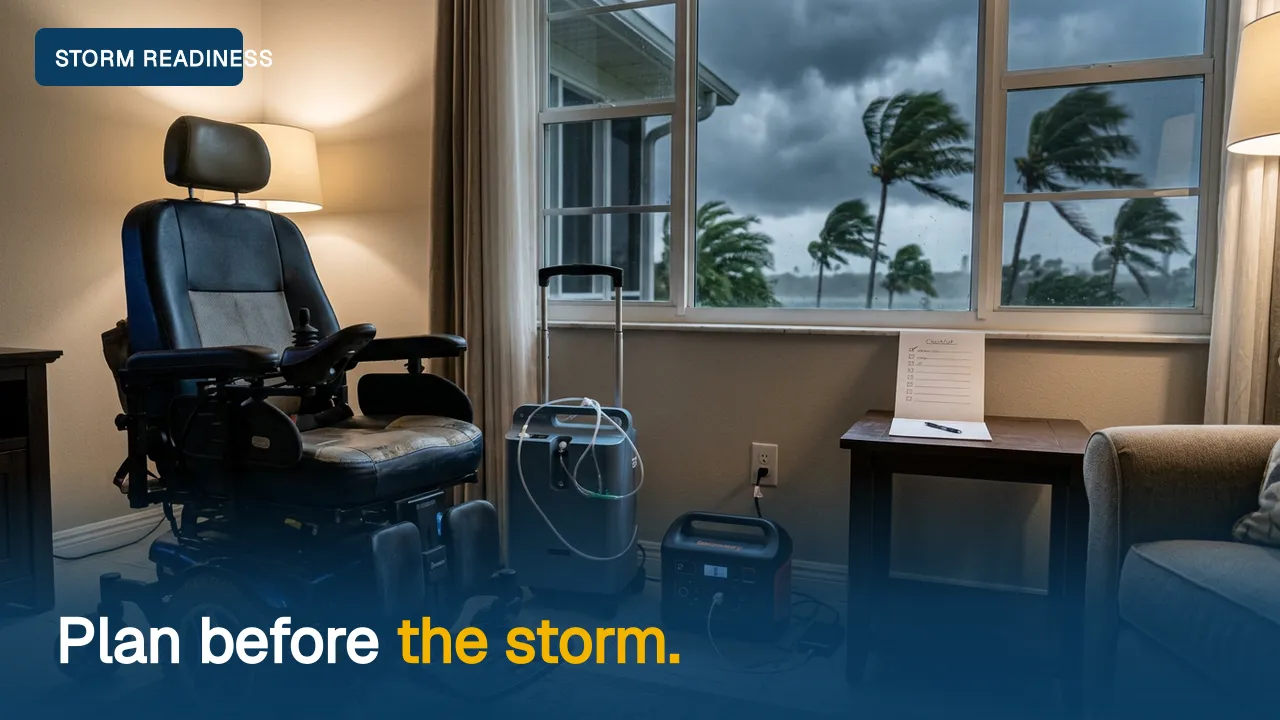
Plan for the power to be out for days, and assume no one will restore yours first. Keep batteries charged, have backup oxygen that needs no electricity, know your evacuation zone, and register with your county's special needs program before hurricane season. Families who make these decisions in May have far fewer emergencies in September.
Your utility will not restore you first
Florida utilities offer medical programs, and they are worth joining. But they do not promise priority restoration. Florida Power & Light says enrollment does not guarantee uninterrupted power, and customers are responsible for backup power. Tampa Electric's Medical Watch program gives advance notice of planned outages but no priority restoration. Duke Energy says the same.
The federal government tracks this risk too. The HHS emPOWER program helps health departments plan for more than 4.6 million Medicare beneficiaries who rely on electricity-dependent medical equipment at home.
Oxygen
- Ask your supplier for backup cylinders that need no electricity. A full E cylinder lasts roughly 5 hours at 2 liters per minute and about 10 hours at 1 liter per minute. Check with your supplier for your exact tank and flow.
- Keep spare batteries and a car charger for any portable concentrator.
- Know the power math. A home concentrator draws roughly 300 to 350 watts. A large 2,000 watt-hour portable power station may run it for only about 4 hours. Plan for days, not hours.
- Keep fire risk low. Oxygen makes things burn faster. Keep it at least 5 feet from flames and heat sources, including candles and gas stoves.
- Have a threshold for leaving. If backup oxygen will run out, go to a special needs shelter or hospital before it does.
Power wheelchairs and scooters
- Charge before the storm. Charge fully when a storm enters the forecast cone, and again before landfall.
- Follow the manufacturer's charging rules. One major manufacturer recommends charging sealed batteries 8 to 14 hours after daily use, never longer than 14. Your manual lists the right time for your chair.
- Ask about generator charging. Some chargers are sensitive to generator power. Ask the manufacturer or your equipment supplier before the storm.
- Keep a manual wheelchair as backup. A power chair with a dead battery is very hard to move.
- Protect the chair. Store it off the floor if flooding is possible and cover the controller.
Generators: the silent danger
More than 400 Americans die each year from carbon monoxide poisoning not linked to fires, and generators are a common cause after storms. Run generators outside only, more than 20 feet from windows, doors and vents. Never in a garage, even with the door open. Put battery-powered carbon monoxide alarms near every sleeping area.
Register and know your zone
- Know your evacuation zone. Look up your address at Florida's Know Your Zone site. Zones run A through F, and Zone A evacuates first.
- Register with the Florida Special Needs Registry. Registration helps local emergency managers plan. It does not guarantee a shelter spot, transportation or rescue.
- Learn how your county's special needs shelter works. Shelters are for people who depend on electricity for equipment such as oxygen, or need help with daily tasks. Bring at least 72 hours of medications and supplies, your equipment and chargers, and your caregiver.
| County | Special needs contact |
|---|---|
| Hillsborough | Emergency Management 813-236-3800; DOH-Hillsborough 813-307-8063 |
| Pinellas | Emergency Management 727-464-3800 |
| Manatee | Emergency Management 941-749-3500 |
Each county runs its program differently. Hillsborough, for example, allows one caregiver and offers transportation if requested at registration. Pinellas does not allow pets in special needs shelters. Check your county's page before June.
Build your plan in May, not September
Write it down: equipment list, battery run times, supplier phone numbers, where you will go, who will drive, and when you will leave. Tape a copy near the equipment.
Our Storm Ready Audit can be added to any home assessment. We inventory every power-dependent device, calculate what backup you actually need, check the home's storm weak points, and give you a written plan. Every service starts with an Initial Consultation, a 30-minute phone call. Current prices are on our pricing page.
Sources
- Florida Division of Emergency Management. Special Needs Registry
- Florida Division of Emergency Management. Know Your Zone
- Florida Department of Health. Special needs shelters
- Hillsborough County. Register for special needs disaster assistance
- Pinellas County. Special needs program
- Manatee County. Special needs program
- Florida Power & Light. Medically essential service
- Tampa Electric. Medical Watch
- Duke Energy. Medically essential program
- U.S. Department of Health and Human Services. emPOWER program
- Centers for Disease Control and Prevention. Carbon monoxide poisoning basics
- Centers for Disease Control and Prevention. Power prep for people who use medical devices
- American Lung Association. Using oxygen safely and power outage preparation
- Quantum Rehab. How to charge your power wheelchair batteries (manufacturer)
- Respiratory Therapy Zone. Calculating oxygen tank duration (education site)
- Generator Checker. Oxygen concentrator battery backup (commercial guide)