
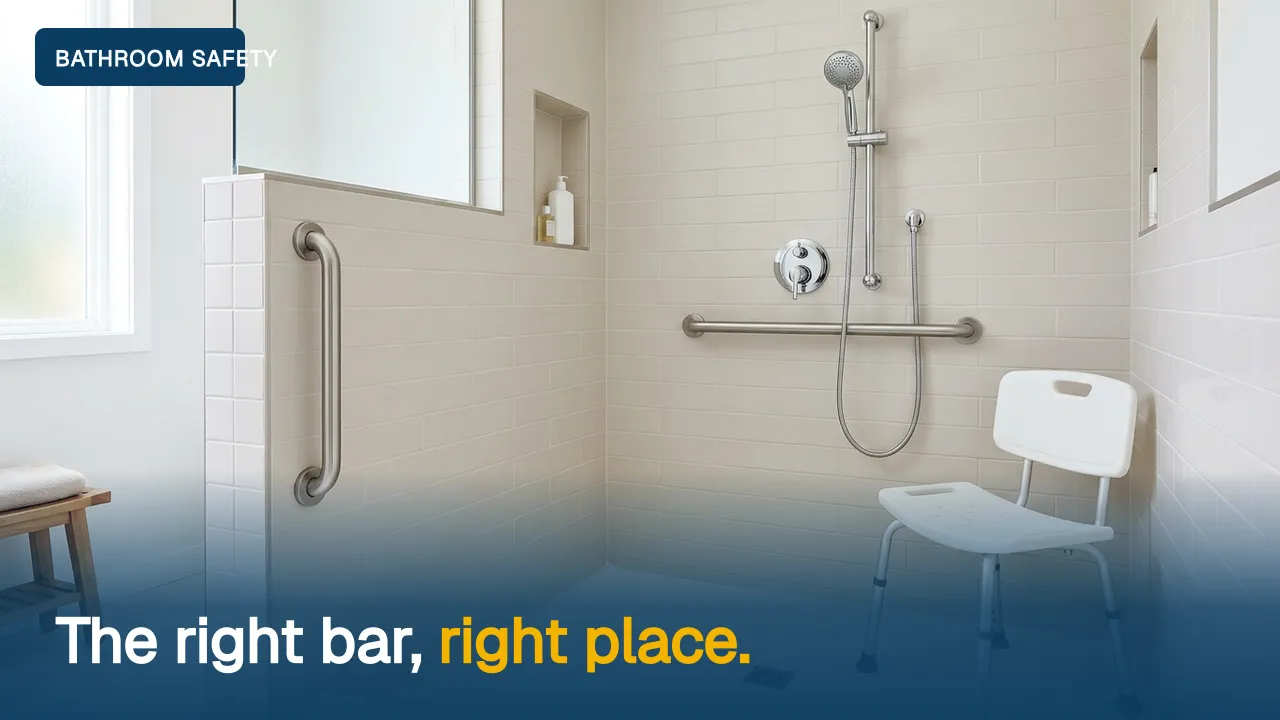
Most people need two to four grab bars: one or two at the tub or shower, and one beside the toilet. The exact number and placement depend on how the person moves, not on a kit. A bar in the wrong spot will not be used, and a bar that is not anchored will fail when it matters most.
Why the bathroom deserves the attention
A CDC study counted about 234,000 emergency room visits in one year for bathroom injuries among people 15 and older. About 81 percent were falls. Roughly two-thirds happened at the tub or shower, and about a quarter at the toilet. Injury rates were highest in people 85 and older.
Grab bars work. In a laboratory study of 63 adults, those given a grab bar were 75.8 percent more likely to recover their balance after a push while stepping out of a slippery tub. A 2026 systematic review in Assistive Technology, the RESNA journal, found that secure rails reduced both the number of people who fell and fall rates.
Where bars usually go
| Location | Typical bar | What it is for |
|---|---|---|
| Tub or shower entry | Vertical bar on the wall at the entry | Steadying while stepping over the tub wall or curb |
| Inside the tub or shower | Horizontal or angled bar on the long wall | Standing, turning, and sitting down on a shower chair |
| Beside the toilet | Horizontal bar on the side wall, or a toilet safety frame | Pushing up to stand and lowering to sit |
| Behind the toilet (sometimes) | Horizontal bar on the rear wall | Extra support for weaker users |
What the standards say, and why they are only a starting point
The ADA Standards set grab bar rules for public restrooms. They are a useful reference:
- Toilet side wall bar at least 42 inches long, starting no more than 12 inches from the rear wall
- Rear wall bar at least 36 inches long
- Mounted 33 to 36 inches above the floor, to the top of the bar
- Bar diameter 1 1/4 to 2 inches, with exactly 1 1/2 inches of space behind it
- Strong enough to hold 250 pounds of force
But a home is not a public restroom. The best height depends on the person's height, reach, strength and how they transfer. A person who pulls up from the toilet needs a bar in a different place from someone who pushes down. Occupational therapy guidance recommends fitting placement to the individual.
Anchoring: the part people get wrong
A grab bar is only as strong as what holds it.
- Into studs or solid blocking. Bars must be screwed into wall framing or wood blocking installed behind the wall, or secured with anchors rated for the wall type.
- Not into drywall alone. Plastic drywall anchors are not enough.
- Tile and fiberglass need care. Tub surrounds and tile walls need the right drill bits and anchors so the bar holds and the wall does not leak.
- Plan ahead when remodeling. If you are renovating, install blocking in all bathroom walls now, even where no bar is going yet.
What not to rely on
- Suction-cup bars. Manufacturers generally label them for balance only, not for holding body weight. They can let go without warning.
- Towel bars, soap dishes and shower doors. None are designed to hold a person's weight, but people grab them when they slip.
- Kits bought by the box. A kit gives you standard bars. It does not tell you where this person needs them.
Who pays
Original Medicare does not cover grab bars. Medicare's national equipment list treats them as self-help devices, not medical equipment. Some Medicare Advantage plans cover bathroom safety devices as a supplemental benefit, and Florida Medicaid's long-term care program may cover some home accessibility changes.
Why a fitted plan beats a kit
In a home safety visit, we watch the person get in and out of the tub or shower and on and off the toilet. Then we specify each bar: length, orientation, height, position and wall type. A contractor can quote and install from that. Start with an Initial Consultation, a 30-minute phone call. Current prices are on our pricing page.
Sources
- Centers for Disease Control and Prevention. MMWR: Nonfatal bathroom injuries among persons aged 15 and older, United States, 2008
- U.S. Access Board. Guide to the ADA Standards: toilet rooms and bathing rooms
- Mayo Clinic. Guide to preventing falls in the bathroom
- Centers for Medicare & Medicaid Services. NCD 280.1 Durable medical equipment reference list
- HealthCraft Products. The hidden hazards of suction grab bars (manufacturer)
- Levine IC, Montgomery RE, Novak AC. Grab bar use influences fall hazard during bathtub exit. Human Factors, 65(8), 1821 to 1829. (Via PubMed.)
- Crosby KM, et al. (2026). The influence of home modifications on falls in community-dwelling older adults: a systematic review. Assistive Technology, 38(2), 176 to 186. (Via PubMed.)