
Oct 23, 2026 · @Dr. Russ L'HommeDieu
> Disclaimer: This information reflects coverage rules as of October 23, 2026, the date it was written. Insurance policies, Medicare rules and plan benefits change frequently and vary by plan and state. All coverage questions must be confirmed directly with your insurance carrier, Medicare plan or equipment supplier before you rely on them. This is general education, not insurance, legal or financial advice.
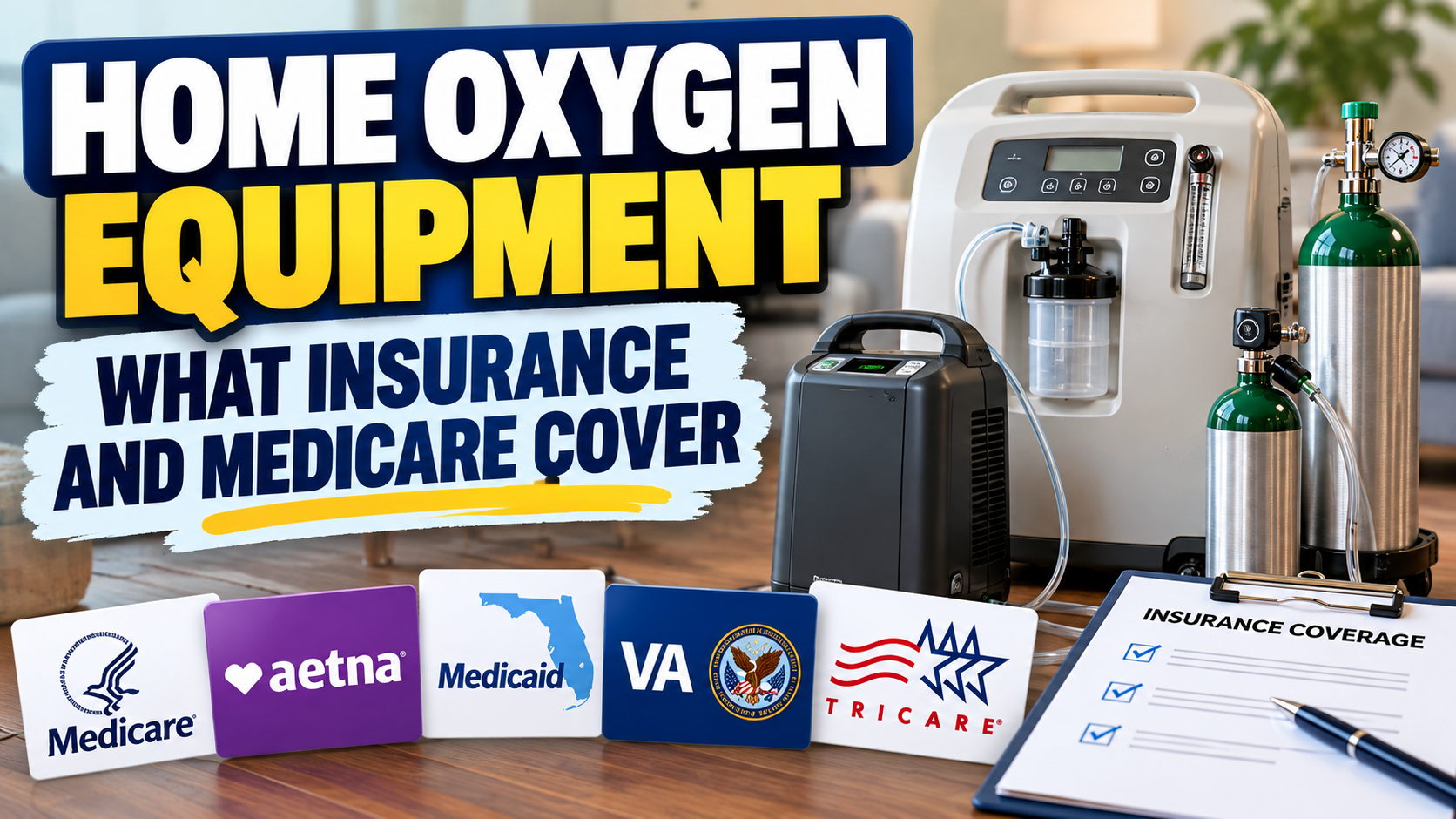
Bottom line: the plug-in concentrator is the easiest item to get covered, backup tanks come bundled rather than paid for separately, and the battery-powered portable concentrator is the hardest. Under Original Medicare, all oxygen equipment is rented, never bought, and the supplier (not the patient) largely decides which equipment you receive.
Coverage at a glance
Wall (stationary) concentrator
- Original Medicare
- Covered as a rental when you qualify; the standard first-line item
- Medicare Advantage
- Covered; plan may require prior authorization and in-network supplier
- Florida Medicaid
- Covered under the state respiratory DME policy, usually through a managed care plan
- VA
- Provided through VA contract vendors
- TRICARE
- Covered if medically necessary; rent or buy
- Private insurance (Aetna as example)
- Covered if criteria met; rental or purchase if cheaper
Portable (battery) concentrator
- Original Medicare
- Covered in principle if you are mobile in the home and did not qualify only during sleep, but the supplier may offer tanks instead
- Medicare Advantage
- Same as Medicare; plan rules vary
- Florida Medicaid
- Check plan; often limited
- VA
- Available through VA vendors when prescribed
- TRICARE
- Covered if medically necessary; may buy or rent
- Private insurance (Aetna as example)
- Covered only if you qualify for ambulatory oxygen and are regularly away longer than tanks last; not covered as a second system
Large backup cylinder
- Original Medicare
- No separate payment; backup is bundled into the rental
- Medicare Advantage
- Same as Medicare
- Florida Medicaid
- Check plan
- VA
- Typically supplied with concentrator setups
- TRICARE
- Ask your regional contractor; TRICARE For Life follows Medicare rules
- Private insurance (Aetna as example)
- One spare tank allowed if you depend on a concentrator
Small travel cylinders
- Original Medicare
- Covered as portable equipment; contents bundled for 36 months, then paid monthly
- Medicare Advantage
- Same as Medicare
- Florida Medicaid
- Check plan
- VA
- Provided through VA vendors
- TRICARE
- Covered if medically necessary
- Private insurance (Aetna as example)
- Covered under portable or ambulatory criteria
In every program, the qualifying test results and a prescription from the treating practitioner come first. Coverage details for each row follow below.
How Original Medicare pays for oxygen
Medicare Part B treats oxygen as rented durable medical equipment with its own special payment rules. Understanding them explains most of the coverage problems people run into.
- Rental only. Medicare pays a monthly rental to the supplier for 36 months. You pay 20% coinsurance after the Part B deductible. Equipment you buy yourself is "statutorily non-covered," meaning Medicare will not pay for it, its accessories or its repairs (CMS Policy Article A52514).
- One payment covers almost everything. The monthly rental for the stationary equipment includes accessories (cannulas, tubing, regulators, stands), delivery, back-up equipment, maintenance, repairs and all oxygen contents. There is no separate payment for a backup tank.
- Months 37 to 60. Rental payments stop, but the supplier who furnished equipment in month 36 must keep providing the equipment, accessories, contents and repairs until the 5-year "reasonable useful lifetime" ends (Medicare.gov).
- After 5 years. You may choose new equipment, which starts a new 36-month rental, from the same or a different supplier.
- Your supplier controls the modality. A supplier may not switch your equipment type unless your doctor orders a change, the supplier swaps in an equivalent item, or you sign an Advance Beneficiary Notice to accept an upgrade at your own cost.
- Your supplier must meet your mobility needs. Medicare.gov states the supplier must provide equipment that fits your needs, including mobility inside and outside the home, and must give you the amount of oxygen you need each month.
- What is never covered: oxygen supplied by an airline, oxygen used outside the United States, pulse oximeters (classed as monitoring devices) and respiratory therapist services under the equipment benefit.
- Pending reform. Oxygen is not included in the next round of Medicare competitive bidding, which starts January 2028 and covers other supplies (AAHomecare). The bipartisan SOAR Act (H.R. 2902 / S. 1406) would further restructure the oxygen benefit but had not passed as of September 2026 (American Lung Association).
The wall (stationary) concentrator
This is the most reliably covered item. Every major payer treats it as the standard home oxygen source once the qualifying test is met.
Original Medicare
- Billed as a monthly rental (HCPCS E1390) for 36 months, with your 20% coinsurance.
- The rental includes tubing, cannulas, humidifier bottles, filters, delivery and repairs. Contents payments do not apply because a concentrator makes its own oxygen.
- Payment is adjusted upward when the prescribed flow is above 4 liters per minute and downward when it is under 1 liter per minute.
- After month 36 you owe no more rental coinsurance. Medicare will pay for a maintenance and servicing visit no more than every 6 months, and you may owe 20% coinsurance on that visit only if the supplier actually comes to your home.
- If you qualify only for oxygen during sleep, the concentrator is the only item covered; no portable system is included.
Other payers
- Medicare Advantage: must cover what Original Medicare covers, but may require prior authorization and an in-network supplier. Your out-of-pocket cost depends on the plan's DME copay or coinsurance.
- Private insurance: Aetna's oxygen policy (CPB 0002) is typical: a stationary system is medically necessary for members who do not regularly go beyond 50 feet of tubing or who use oxygen only during sleep. Aetna will cover rental, or purchase if purchase is less costly.
- Electricity is not covered. No payer reimburses the power bill, and Aetna's policy states that electrical generators do not qualify as durable medical equipment.
The portable (battery) concentrator
Most patients want the lightest battery-operated concentrator they can get, because a small unit that fits over a shoulder makes errands, appointments, visits with family and travel far easier than pulling a tank cart. Unfortunately, a portable oxygen concentrator (POC), and especially the lightest models, is the item people most often fail to get covered. The obstacle is usually the payment model, not the medical criteria. Keep in mind that the lightest units generally deliver smaller pulse doses, so the right POC is the lightest one that still meets your prescription during activity.
What Medicare's rules say
- A portable system, including a POC (HCPCS E1392), can be covered when you are mobile within the home and your qualifying test was done while awake, at rest or during exercise. People who qualify only during sleep do not get a portable system (NCD 240.2).
- To be billed as a POC, the device must run on AC and DC power, provide at least 2 hours on battery at a 2 L/min equivalent, and weigh 20 pounds or less with that battery. If a POC can also run 24 hours a day as a home unit, the supplier may bill it as both a stationary and a portable concentrator (CMS Policy Article A52514).
- Medicare does not pay for oxygen used on airplanes, and Medicare.gov notes your supplier is not required to give you an airline-approved POC.
Why suppliers often offer tanks instead
- The supplier receives essentially the same bundled monthly payment whichever portable modality it chooses, and a POC costs far more to buy and maintain than cylinders.
- After month 36, Medicare pays a monthly contents fee only to patients using gaseous or liquid tanks. A patient on concentrators (stationary and portable) generates no contents payment, only a maintenance visit every 6 months. The financial incentive favors tanks.
- The supplier chooses the modality. You can ask your doctor to write an order specifying a POC and documenting why (for example, you are regularly out of the home longer than tanks last, or you cannot safely handle cylinders), but a supplier may still decline to furnish one. If so, you can look for a different Medicare-enrolled supplier that does.
- You may accept an upgrade by signing an Advance Beneficiary Notice and paying the difference, if the supplier offers that option.
Buying your own POC
Many people buy a POC out of pocket (typically a few thousand dollars) for travel and errands while keeping their Medicare-rented home system. Medicare pays nothing toward a purchased unit, and its accessories, batteries and repairs are also non-covered. Oxygen equipment is an eligible medical expense for HSA and FSA funds and the itemized medical deduction (IRS Publication 502).
Private insurance
Under Aetna's policy, a POC is covered only as an alternative to an ambulatory tank system, and only if you both (1) regularly go beyond 50 feet of tubing for 2 or more hours a day on most days (at least 6 hours a week) and (2) are away from home at least monthly for longer than ambulatory tanks would last. Aetna treats a stationary concentrator plus a POC as a duplicate "convenience" system and does not cover the pair. Other commercial insurers use similar criteria, so check your plan's medical policy.
Oxygen tanks: large backup and small travel cylinders
Tanks are covered, but how they are paid depends on whether they are your portable system or your emergency backup.
Small travel cylinders (your portable system)
- Covered under Medicare as portable gaseous equipment (HCPCS E0431, or K0738 for a home fill system that refills small cylinders from a concentrator), when you are mobile in the home and did not qualify only during sleep.
- For the first 36 months, the oxygen in the tanks is included in the stationary rental. Suppliers must provide whatever quantity of oxygen you need for activities both inside and outside the home, and may deliver up to 3 months of contents at a time (CMS Policy Article A52514).
- After month 36, if you were using portable tanks in the 36th month, Medicare begins a separate monthly payment for portable contents (E0443), with your 20% coinsurance, through the 5-year lifetime.
- A home fill system means fewer deliveries, but no contents payment follows, so it is mainly a supplier's choice.
Large backup cylinders
- Medicare does not pay separately for a backup tank. "Back-up equipment" is included in the monthly rental allowance, so whether you get one, and how many, depends on your supplier's practices. Ask before you sign on, especially in hurricane areas.
- Aetna considers one spare tank medically necessary for a member who depends on a concentrator or on continuous oxygen, but treats "emergency or standby" systems beyond that as not medically necessary (Aetna CPB 0002).
- If you need more backup oxygen than your supplier provides for a predictable outage (for example, an approaching hurricane), ask the supplier for extra cylinders in advance and ask what, if anything, you would pay.
Tanks you own
If you own a gaseous or liquid system (for example, you entered Medicare already owning it), Medicare will still pay for the oxygen contents, but not for the equipment, accessories or repairs.
Medicare Advantage and Medigap
Medicare Advantage (Part C) plans must cover the same oxygen benefit as Original Medicare, but they can change how you get it:
- Prior authorization is common for oxygen equipment, and especially for a portable concentrator.
- Network suppliers only, in most HMO plans. Using an out-of-network supplier can mean no coverage.
- Different cost sharing: a fixed copay or a coinsurance percentage for durable medical equipment, counted toward the plan's annual out-of-pocket maximum.
- Travel and snowbirding are harder outside the plan's service area. Confirm in writing how the plan handles oxygen when you are away for weeks or months.
- Read the plan's Evidence of Coverage before open enrollment and ask directly whether its contracted suppliers furnish POCs.
Medigap (Medicare Supplement) works only with Original Medicare. It pays some or all of your share of Medicare-approved costs, such as the 20% coinsurance on oxygen rentals and contents, depending on the plan you buy (Medicare.gov). Medigap never pays for equipment Medicare itself does not cover, such as a POC you purchase.
If Medicare changes partway through: joining a Medicare Advantage plan, a hospital stay or a nursing facility stay is treated as a break in billing; when you return to Original Medicare and still need oxygen, the 36-month count resumes where it left off.
Medicaid, the VA and TRICARE
Florida Medicaid
- Home oxygen equipment falls under the Florida Medicaid Durable Medical Equipment and Medical Supply Services Coverage Policy: Respiratory (December 2023), adopted by rule 59G-4.074 effective January 10, 2024 (Florida Administrative Code).
- Most Florida Medicaid members receive DME through a Statewide Medicaid Managed Care plan, so the plan's prior authorization rules and supplier network apply. Ask the plan specifically about portable concentrators and backup cylinders.
- Dual eligibles (Medicare and Medicaid): Medicare pays first. Depending on the person's Medicaid category, Medicaid may cover the Medicare 20% coinsurance.
- Other states differ. For example, Washington's Medicaid rules state it does not pay separately for spare tanks for backup or travel, so always check your own state's policy.
Veterans Affairs (VA)
- Enrolled veterans receive home oxygen through the VHA Home Oxygen Program, which contracts with private vendors to deliver and maintain the equipment. The program spent about $257 million in fiscal year 2020 (VA Office of Inspector General, 2021).
- A VA clinician prescribes the oxygen and a VA respiratory therapist evaluates the needed level; under VHA Directive 1173.13 (August 2020), new patients are reevaluated within 3 months.
- The VA is not bound by Medicare's rental and supplier-incentive rules, and VA home oxygen contracts typically include stationary and portable concentrators, liquid systems and cylinders. Ask your VA prosthetics office or home oxygen coordinator what your local contract includes and whether any copay applies to you.
- Veterans who also have Medicare can choose which benefit to use, but both should not furnish the same equipment.
TRICARE
- TRICARE covers portable oxygen when it is medically necessary, and the beneficiary may rent or buy an oxygen concentrator (TRICARE FAQ). The option to purchase is a notable difference from Medicare.
- TRICARE For Life beneficiaries in the U.S. must follow Medicare's oxygen rules, because Medicare pays first.
Private and employer insurance
Commercial plans generally copy Medicare's qualifying test (oxygen saturation of 88% or less, or PaO2 of 55 mm Hg or less, in a stable state) but write their own rules for which equipment they will pay for. Aetna CPB 0002, last reviewed March 2026, is a representative example:
| Equipment | When Aetna considers it medically necessary |
|---|---|
| Stationary system (concentrator or large cylinder) | You do not regularly go beyond 50 feet of tubing, or you use oxygen only during sleep |
| Portable system (10 lb or more, on wheels) | You occasionally go beyond 50 feet of tubing, less than 2 hours a day on most days (at least 2 hours a week) |
| Ambulatory system (under 10 lb, lasts 4 hours at 2 L/min) | You regularly go beyond 50 feet for 2 or more hours a day on most days (at least 6 hours a week) |
| Portable oxygen concentrator | You meet the ambulatory criteria and are away from home at least monthly for longer than ambulatory tanks last |
| Spare tank | One tank, if you depend on a concentrator or on continuous oxygen |
| Airline oxygen tank rental | You qualify for home oxygen and the airline will not allow your own portable unit |
Not covered under that policy: a stationary concentrator and a POC together, emergency or standby systems beyond one spare tank, ambulatory systems or POCs for people who qualify only during sleep, and generators.
What to check in your own plan: whether DME is a covered benefit at all, the deductible and coinsurance for DME, prior authorization requirements, in-network suppliers, and whether the plan will rent or buy. Self-funded employer plans and marketplace plans each publish their own medical policies.
Travel, out-of-pocket purchases and tax help
Traveling with Medicare oxygen
- If you travel or temporarily relocate outside your supplier's area (for example, a snowbird season), your home supplier must either provide your equipment or arrange it through another supplier for the month already billed. In months 37 to 60, the home supplier is required to provide or arrange the equipment wherever you go in the U.S. (CMS Policy Article A52514). Give your supplier plenty of notice.
- Air travel: only FAA-approved portable concentrators may be used on board, and Medicare will not pay for them or for airline oxygen. Many people rent a POC from a travel rental company or buy their own.
- Medicare does not cover oxygen outside the United States and its territories.
Paying out of pocket
- Buying a POC, extra batteries, a generator or extra cylinders is common. None of these purchases is covered by Original Medicare.
- Tax-advantaged funds: IRS Publication 502 lists "oxygen and oxygen equipment to relieve breathing problems caused by a medical condition" as a medical expense, so HSA and FSA funds can be used, and unreimbursed costs count toward the itemized medical deduction above 7.5% of adjusted gross income (IRS Publication 502).
- Keep the prescription and receipts.
Policy changes to watch
- Competitive bidding: oxygen is not part of Medicare's Round 2028 competitive bidding program, which instead covers items such as diabetes devices, ostomy and urological supplies and off-the-shelf braces (AAHomecare).
- SOAR Act (H.R. 2902 / S. 1406): would remove oxygen from competitive bidding permanently, create a separate payment for liquid oxygen, add payment for respiratory therapist services and establish patient protections. As of September 15, 2026, it had 69 House and 9 Senate sponsors but had not passed (American Lung Association).
Practical tips for getting the equipment you need
- Get the right test, documented correctly. The qualifying test must be ordered by your treating practitioner, done within 30 days before the equipment is delivered, and, for a portable unit, done while awake (at rest or with exercise), not only during sleep.
- Ask your doctor to be specific. The order should name the equipment (for example, "portable oxygen concentrator, pulse dose, setting 2 with activity"), the hours of use, and why you need it outside the home.
- Interview suppliers before you choose one. Ask: Do you furnish portable concentrators to Medicare patients? Do you provide a backup cylinder, and how many? What is your after-hours number? How do you handle travel and hurricanes? Use the medical equipment supplier search on Medicare.gov to find enrolled suppliers.
- Choose carefully at the start. The supplier who furnishes your equipment in month 1 is generally the one you stay with for 36 months, and the month-36 supplier is responsible through year 5. Switching is allowed but resets nothing.
- Hold the supplier to its obligations. It must provide the quantity of oxygen you need inside and outside the home and equipment that fits your mobility needs. If it refuses, call 1-800-MEDICARE or your plan.
- Plan for year 5. After the 5-year lifetime, you can request new equipment, including a different modality, from any supplier.
- Veterans and TRICARE members: compare what the VA or TRICARE will provide before defaulting to Medicare, since their rules differ.
- Appeal denials. Medicare, Medicare Advantage, Medicaid and commercial plans all have written appeal processes. A letter from your physician explaining medical necessity is the most important document.
Sources
All links were opened and confirmed live on October 23, 2026.
- Centers for Medicare & Medicaid Services. Oxygen and Oxygen Equipment, Policy Article A52514.
- Centers for Medicare & Medicaid Services. National Coverage Determination 240.2: Home Use of Oxygen.
- Medicare.gov. Oxygen equipment & accessories.
- Medicare.gov. What's Medicare Supplement Insurance (Medigap)?
- Aetna. Clinical Policy Bulletin 0002: Oxygen. Last reviewed March 10, 2026.
- Florida Administrative Code. Rule 59G-4.074, Durable Medical Equipment and Medical Supply Services: Respiratory.
- VA Office of Inspector General. Inadequate Oversight of VHA's Home Oxygen Program. December 16, 2021.
- TRICARE. Does TRICARE cover portable oxygen?
- Internal Revenue Service. Publication 502 (2025), Medical and Dental Expenses.
- American Association for Homecare. Medicare Competitive Bidding: Round 2028.
- American Lung Association. Hundreds of Patients and Advocates Call on Congress to Pass Life-Changing Oxygen Reform. September 15, 2026.
Not linked: the observation that suppliers often substitute tanks for portable concentrators, and Washington State's Medicaid rule on spare tanks, come from industry and state sources reviewed in search results but not opened in full. Coverage rules change; confirm current details with your plan or supplier.