
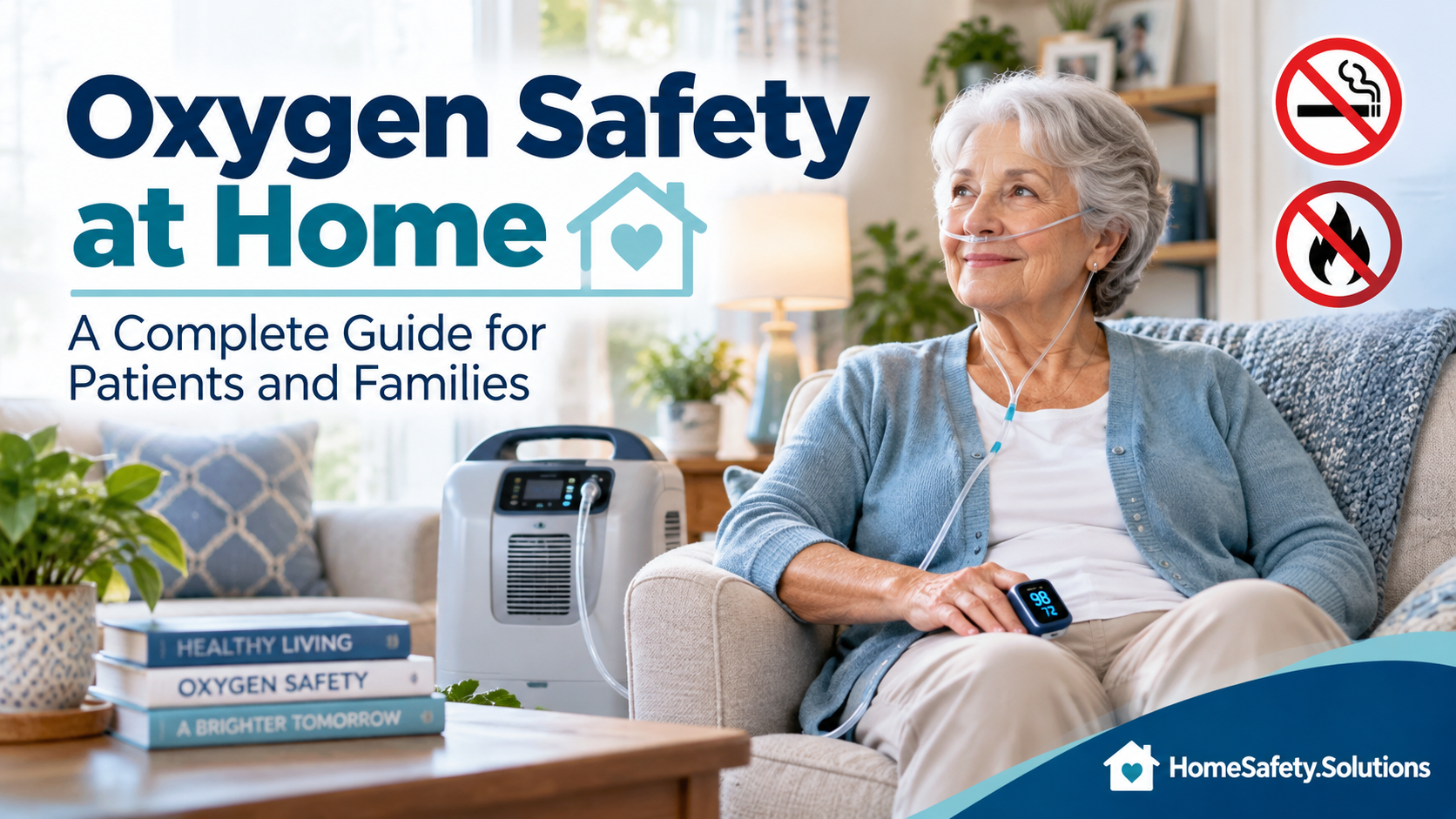
Oct 23, 2026 · @Dr. Russ L'HommeDieu
Home oxygen is safe and life-extending when it is used the right way, and dangerous when it is not. Oxygen itself does not burn, but it makes everything around it burn faster and hotter, and the tubing and tanks that deliver it add real fall and injury risks inside the home.
This guide is written for people who use oxygen, their families and caregivers, and the clinicians who support them. It covers who qualifies under Medicare, the four kinds of equipment most people end up with, how to use a pulse oximeter, and the fire, fall, cylinder and power-outage hazards that a home safety assessment should address.
This article is for education only. Always follow the prescription and instructions from your own physician and oxygen supplier. Never change your oxygen flow rate without talking to your prescriber.
Who qualifies for home oxygen under Medicare
Medicare covers home oxygen when a test shows hypoxemia: an arterial oxygen pressure (PaO2) of 55 mm Hg or less, or an oxygen saturation of 88% or less, measured while breathing room air. The rules come from the Medicare National Coverage Determination for Home Use of Oxygen (NCD 240.2), last revised effective September 27, 2021. That revision allows coverage for both acute and chronic conditions, short or long term.
| Group | Qualifying result | When it is measured | What is covered |
|---|---|---|---|
| Group I, at rest | PaO2 at or below 55 mm Hg, or SpO2 at or below 88% | Awake, at rest, room air | Continuous oxygen; stationary and portable equipment |
| Group I, during sleep | PaO2 at or below 55 mm Hg or SpO2 at or below 88% during sleep, in someone who is 89% or higher awake; or a drop of more than 5 points in saturation with symptoms such as confusion, restlessness or insomnia | Overnight study | Oxygen during sleep only; one stationary unit, no portable |
| Group I, with exercise | PaO2 at or below 55 mm Hg or SpO2 at or below 88% during exercise or functional activity, in someone who is 89% or higher at rest | Walking or formal exercise test, with a test on oxygen showing improvement | Oxygen during activity |
| Group II | PaO2 of 56 to 59 mm Hg or SpO2 of exactly 89%, plus one of: dependent edema suggesting heart failure; pulmonary hypertension or cor pulmonale; or hematocrit above 56% | Rest, sleep or exercise | Same as Group I |
How testing works
- The test must be ordered and evaluated by the treating practitioner. An arterial blood gas or pulse oximetry is acceptable, but the oxygen supply company (the DME supplier) may not perform the qualifying test.
- Testing must be done at the "time of need." For someone leaving the hospital, that means within 2 days of discharge.
- If a blood gas and an oximetry reading disagree, Medicare relies on the blood gas.
- Reviewers are instructed to consider factors that affect readings, including age, skin pigmentation and altitude.
What Medicare will not cover
NCD 240.2 excludes oxygen for chest pain (angina) without low oxygen, breathlessness without low oxygen or cor pulmonale, poor circulation in the limbs, and terminal illness that does not affect breathing.
Portable oxygen
Medicare contractors may cover a portable system for people who are mobile in the home, either alone or in addition to a stationary concentrator. People who qualify only for oxygen during sleep do not get a portable unit.
How Medicare pays
Oxygen equipment is rented, never purchased. According to Medicare.gov, Medicare pays a monthly rental for 36 months, and you pay 20% coinsurance after the Part B deductible. The supplier must keep the equipment working and provide supplies for up to 5 years total. After 5 years, you can get new equipment and a new 36-month cycle begins. Medicare does not pay for oxygen equipment used only for air travel.
Medicare Advantage plans follow the same coverage rules but may require prior authorization or in-network suppliers. Check with your plan.
The four kinds of home oxygen equipment
Most people on long-term oxygen end up with a combination: a plug-in concentrator as the main source, a portable unit or small tanks for leaving the house, and one or more large cylinders as backup. Each has its own strengths and its own hazards.
| Equipment | What it is | Best for | Main safety concerns |
|---|---|---|---|
| Stationary (home) concentrator | A plug-in machine, often 30 to 50 lb, that pulls oxygen out of room air and delivers continuous flow through long tubing | Primary 24-hour or overnight oxygen at home | Stops working in a power outage; long tubing is a trip hazard; needs airflow around it; generates heat |
| Portable oxygen concentrator (POC) | A battery-powered machine, roughly 3 to 20 lb, usually delivering pulse (on-demand) doses; some models also offer continuous flow | Errands, travel, flights, moving around the house | Battery runs out; pulse settings are not the same as liters per minute; many pulse units are not suitable for sleep |
| Large cylinder (backup) | A tall steel or aluminum tank of compressed oxygen, usually on a wheeled stand | Backup when the power goes out or the concentrator fails | High pressure; can tip and break the valve; needs secure storage and distance from heat |
| Small travel cylinders | Lightweight tanks (often called E, D or M6 sizes) carried in a cart or shoulder bag, often with a conserving regulator | Short outings, appointments, car trips, emergency evacuation | Run out faster than people expect; must be secured in the car; never left in a hot vehicle |
Stationary concentrator
A home concentrator never needs refilling, which makes it the workhorse for most users. The trade-off is total dependence on household electricity.
- Place it where air can circulate, not against a wall, curtain or furniture, and not in a closet, behind drapes or near a heat source. Many suppliers recommend about 12 inches of clearance on all sides.
- Plug it directly into a wall outlet. Do not use extension cords or power strips, and do not share the outlet with major appliances such as space heaters or air conditioners.
- Clean the air filter as the manufacturer directs, and use distilled water only if a humidifier bottle is prescribed.
- Learn the alarms. Most units alarm for power loss, low oxygen purity, high temperature and kinked or blocked tubing.
Portable oxygen concentrator
A POC gives freedom to leave the house without hauling tanks, and many models are FAA-approved for flights. Two points cause real harm when they are misunderstood.
- Pulse dose is not liters per minute. A pulse setting of 2 does not equal 2 L/min of continuous flow. Your prescription must state the device and setting, and you should be tested on that device during activity.
- Not every POC works for sleep. Pulse units may not trigger reliably with shallow breathing during sleep or with a CPAP mask. Use the device your prescriber approved for nighttime.
- Keep spare batteries charged. Airlines generally require battery capacity for well beyond the length of the flight, so check with the airline before you book.
Large backup cylinder
A large cylinder provides oxygen with no electricity at all, which makes it the most reliable backup during hurricanes, storms and equipment failures. It holds compressed gas at roughly 2,000 psi or more, so it must be stored and handled carefully (see Cylinder safety below).
- Ask your supplier how long a full cylinder lasts at your prescribed flow rate, and write that number on your emergency plan.
- Keep a regulator and a spare cannula with it so it can be connected quickly in the dark.
Small travel cylinders
Small cylinders are light and simple but finite. A full E cylinder, for example, lasts under 3 hours at 4 L/min of continuous flow (UVM Health). Conserving regulators stretch that time, but only for people who have been tested on them.
- Always leave the house with more oxygen than you think you need for the trip, plus a margin for traffic or delays.
- Check the pressure gauge before you go, and turn the cylinder valve fully off when not in use.
Some people use liquid oxygen instead of compressed gas. It holds much more oxygen in a small space but is extremely cold (about minus 297°F), must always be kept upright, and can cause frostbite on contact. Follow your supplier's specific instructions if you use it.
The pulse oximeter: your oxygen dashboard
A fingertip pulse oximeter tells you whether your oxygen is doing its job. It is inexpensive, painless and, used correctly, one of the most useful tools a home oxygen user can own.
What it actually measures
A pulse oximeter shines red and infrared light through the fingertip and reads two numbers:
- SpO2 (oxygen saturation): the percentage of hemoglobin in your arterial blood that is carrying oxygen. Most healthy adults read 95% to 100%. Your prescriber will give you your own target range, which is often lower for people with chronic lung disease.
- Pulse rate: heartbeats per minute.
Just as important is what it does not measure. It does not measure how well you are breathing out carbon dioxide, how much hemoglobin you have (someone with anemia can read normal yet be short on oxygen delivery), or carbon monoxide poisoning, which can produce a falsely normal reading.
How to get an accurate reading
The FDA notes that poor circulation, skin pigmentation, skin thickness, skin temperature, current tobacco use and fingernail polish can all affect accuracy.
- Sit and rest for a few minutes first.
- Warm your hands if they are cold.
- Remove nail polish or artificial nails from the test finger.
- Rest your hand below heart level and keep it still.
- Wait until the number settles (usually 30 to 60 seconds), then record it.
Skin tone and accuracy
Research since the 1980s, and an FDA safety communication in 2021, show that pulse oximeters can overestimate oxygen levels in people with darker skin. In January 2025 the FDA issued draft guidance to improve testing across skin tones. Medicare's coverage rules also instruct reviewers to consider skin pigmentation when interpreting readings. If you have darker skin, pay close attention to symptoms, not just the number, and tell your clinician if your readings seem out of line with how you feel.
Using it well
- Watch trends, not single numbers. Keep a simple log of readings at rest, during activity and on waking.
- Check it during the activities that matter: walking, bathing, climbing stairs and after meals. These are the moments when oxygen often drops.
- Never change your flow rate based on a reading. Call your prescriber instead. Too little oxygen harms the heart and brain; too much can be dangerous for some people with COPD.
- Prefer an FDA-cleared prescription-grade device over one sold as a "wellness" or "sports" product, which is not reviewed by the FDA.
Call 911 for severe shortness of breath, chest pain, confusion, unusual drowsiness, or blue or gray lips or fingertips, whatever the oximeter says.
Oxygen tubing and fall risk
The tubing that lets someone move around the house is also one of the most common causes of falls in oxygen users. A matched-cohort study of people with COPD found those on supplemental oxygen had about 70% more slips, trips and falls at three months than similar patients without it (Thomas Jefferson University). Hip fractures from tripping over home oxygen tubing have been reported in the medical literature for decades.
Why tubing is so hazardous
- It is nearly invisible. Standard tubing is clear and blends into carpet and flooring.
- It is long. A home concentrator may run 25 to 50 feet of tubing so the user can reach every room, and that tubing loops behind them as they walk.
- It catches. Tubing snags on door frames, furniture legs, walker and wheelchair wheels, recliner mechanisms and pets.
- It coils around feet when the user turns, pivots or backs up to sit down.
- It shows up at the worst times: nighttime bathroom trips, on stairs, and when someone is short of breath and hurrying.
- The user is often already at risk: low oxygen itself impairs balance and thinking, and many users also have deconditioning, neuropathy or medications that affect balance.
Practical fixes
- Make it visible. Use colored tubing, or wrap bright tape around clear tubing every 12 inches or so.
- Use the shortest tubing that works. Use a long line for daytime moving around and a shorter line at night if the bed and bathroom are close to the concentrator.
- Add a swivel connector near the cannula so the tubing turns with you instead of twisting and kinking.
- Route tubing along walls, not across the middle of walkways or doorways. Do not run it under rugs or doors, where it can be crushed and kinked unseen.
- Manage the slack. Use a tubing reel, a retractable or self-coiling line, or clip the tubing to the back of your shirt so it trails behind rather than around your feet.
- Use a portable unit for stairs and longer distances instead of dragging a long line between floors.
- Light the path. Put night-lights from the bedroom to the bathroom, and keep a lamp within reach of the bed.
- Slow down at transitions. Before you turn, stand up or sit down, glance down and check where the tubing is.
- Check for kinks. A kinked or pinched line can cut off oxygen without you noticing, and many concentrators will alarm.
- Protect your skin. Pressure from the cannula can cause sores over the ears and nose; foam ear covers and water-based moisturizer help.
The bigger picture
Tubing management works best as part of a full fall-risk assessment: clutter and rug removal, grab bars, bathroom setup, footwear, lighting, medications and strength and balance training. A physical or occupational therapist can assess how a person actually moves through their home on oxygen and tailor the setup to them.
Fire: why oxygen and flames never mix
Oxygen is not flammable, but it makes everything else far more flammable. Smoking is the leading cause of home oxygen fires, burns and deaths, according to the National Fire Protection Association (NFPA).
The science of an oxygen-enriched home
Room air is about 21% oxygen. Fire needs three things: fuel, heat and oxygen. When medical oxygen flows into a room, it raises the oxygen level around the user, and that changes how fire behaves:
- Things ignite more easily. Materials that would only smolder in normal air can burst into flame.
- Fire burns hotter and spreads faster. A small spark becomes a flash fire in seconds.
- Oxygen soaks in. The NFPA warns that oxygen saturates fabric-covered furniture, clothing, hair and bedding. The enriched air does not stay at the cannula; it permeates the user's clothes, beard, pillow and chair, and it lingers after the oxygen is turned off.
- Fire can travel up the tubing. A lit cigarette near the nose can ignite the cannula, sending flame along the tubing toward the oxygen source and causing severe facial and airway burns.
This is why there is no safe way to smoke, vape or have an open flame near someone using oxygen. Turning the oxygen "off for a minute" is not enough, because the clothing and furniture remain oxygen-enriched for a while afterward.
How big is the problem?
- An NFPA analysis of 2017 to 2021 emergency room data found home medical oxygen was involved in an average of about 1,041 thermal burns per year.
- NFPA estimated about 70 deaths per year from home fires involving oxygen equipment (2011 to 2015), and called its figures likely underestimates.
- Medical oxygen was involved in 13% of home smoking-material fire deaths (NFPA, 2019).
- A 2019 analysis of U.S. media reports by BPR Medical estimated a patient dies about every four days in a home oxygen fire.
Rules for every home with oxygen
- No smoking, vaping or e-cigarettes in the home, by anyone, at any time. Post "No Smoking" and "No Open Flames" signs at the entrance and in every room where oxygen is used.
- No open flames: candles (including birthday candles), matches, lighters, gas stoves, fireplaces, wood stoves, oil lamps, incense and fire pits.
- Keep oxygen equipment and tubing at least 5 feet from any heat source; many suppliers and fire services recommend 10 feet. That includes space heaters, radiators, furnaces and stovetops.
- Do not cook on a gas stove while wearing oxygen. Use a microwave or an electric appliance, or have someone else cook.
- Avoid spark sources near the cannula: electric razors, hair dryers, curling irons, heating pads and electric blankets. Ask your supplier which electrical items are safe in your setup.
- No oil-based products on the face or upper body. Petroleum jelly (Vaseline), vapor rubs, oily lotions and some hair products can ignite. Use water-based products such as aloe vera or K-Y Jelly for dry lips and nostrils.
- No aerosol sprays (hairspray, air freshener, spray paint) and no flammable liquids (nail polish remover, rubbing alcohol, paint thinner, gasoline) near oxygen.
- Alcohol hand sanitizer: rub it in until your hands are completely dry before touching oxygen equipment.
- Prefer cotton clothing and bedding; wool and synthetics build static.
Firebreaks and alarms
- Ask your supplier for oxygen firebreaks (thermal fuses). These small valves fit in the tubing and automatically stop oxygen flow if the tubing catches fire. The International Association of Fire Chiefs recommended their use in 2022, and they are required in parts of Europe.
- Install working smoke alarms on every level and outside every sleeping area, and test them monthly.
- Keep a fire extinguisher where you can reach it, and know how to use it.
- Tell your local fire department that oxygen is used and stored in your home.
If a fire starts
Turn off the oxygen only if you can do so instantly and safely. Get out, stay out, and call 911. Tell firefighters that oxygen cylinders are inside and where they are.
Cylinder safety: managing tanks under pressure
A full compressed-oxygen cylinder holds gas at roughly 2,000 psi, more than 60 times the pressure in a car tire. Treat every cylinder, full or nearly empty, as if it is full, because there is no reliable way to tell by looking.
Why a falling cylinder is dangerous
If an upright cylinder tips over and the valve snaps off, the escaping gas can turn the cylinder into a projectile that can break through walls. A falling cylinder can also crush a foot, injure a child or pet, or damage the regulator and cause a leak. Even a minor leak raises the oxygen level in a closed space and creates a fire hazard.
Storage
- Secure every cylinder so it cannot fall or roll: upright in a supplier-approved stand, cart or rack, or chained to a wall, or lying flat where it cannot roll. Never lean a cylinder against a wall or furniture.
- Store in a well-ventilated area, away from direct sun. Avoid closets, cabinets and other enclosed spaces where leaking oxygen can build up. Follow your supplier's guidance on whether under-bed storage is acceptable.
- Keep at least 5 to 10 feet from heat and open flame. Heat raises the pressure inside the cylinder.
- Keep away from flammables: gasoline, paint, propane tanks, oils and grease. Do not store oxygen in a garage next to fuel or a car.
- Do not block exits. Store cylinders where they will not trap anyone in a fire.
- Separate full from empty and label them so the supply company can rotate them correctly.
- Keep children and pets away from cylinders and regulators.
Handling and use
- Open the valve slowly with the proper wrench or handle, and never force it or use pliers or a hammer.
- Close the cylinder valve completely when not in use, not just the flow knob on the regulator.
- Never oil or grease a valve or regulator, and never handle equipment with oily or lotion-covered hands. Oil and high-pressure oxygen can ignite violently.
- Never try to repair, modify, refill or transfer oxygen between cylinders unless the supplier gave you a home-fill system and trained you on it.
- Listen for leaks. If you hear hissing, close the valve, ventilate the room, keep all flames and sparks away, and call your supplier. Never search for a leak with a flame.
- Watch the gauge and order refills early so you never run low, especially before holidays, weekends and storms.
Cylinders in the car
- Secure cylinders upright in a holder or lying flat on the floor behind the front seat so they cannot roll. Never put them loose on a seat.
- Carry them in the passenger compartment with a window slightly open, not in the trunk.
- Never leave oxygen in a parked car. In a Florida summer, the inside of a closed car can climb well above 120°F within an hour.
- No smoking in the vehicle, ever.
Power outages: planning for a concentrator that stops
If you depend on a plug-in concentrator, a power outage is a medical emergency, not an inconvenience. Oxygen concentrators are among the most common electricity-dependent medical devices in American homes, and in hurricane country outages can last days.
Every concentrator user needs at least one backup that does not depend on household power, and ideally two layers.
Backup options compared
| Backup | How it works | Strengths | Limits |
|---|---|---|---|
| Backup oxygen cylinders | Large and small tanks of compressed oxygen from your supplier | Needs no electricity; works immediately | Finite supply; must be stored securely; deliveries may stop during a storm |
| Portable concentrator batteries | Charged POC batteries | Lightweight; good for evacuation | Hours, not days; pulse mode may not match a continuous-flow prescription |
| Generator | Gas, propane or whole-house generator powering the concentrator | Can run for days with fuel | Carbon monoxide risk; fuel storage near oxygen; must be outdoors |
| Portable power station | Large rechargeable battery | Quiet; safe indoors | A home concentrator drawing about 350 watts drains a 2,000 watt-hour station in under 6 hours |
Build your plan before the storm
- Know your numbers. Ask your supplier exactly how many hours each backup cylinder lasts at your prescribed flow, and how long each POC battery lasts on your setting. Write them on your plan and post it near the concentrator.
- Keep enough backup oxygen on hand to bridge the time until power returns, your supplier can deliver, or you can get to a location with power. Ask your supplier for extra cylinders before hurricane season and before any named storm.
- Register with your electric utility. In Florida, FPL offers a Medically Essential Service program and Tampa Electric offers Medical Watch. These provide advance storm notices, but they do not guarantee priority restoration.
- Register with the Florida Special Needs Registry at snr.flhealthresponse.com so emergency managers know you need a special needs shelter or transportation. In Hillsborough County, the Department of Health special needs program can help at (813) 307-8063. Other states have similar county registries.
- Plan where you will go if power will be out longer than your backup lasts: a family member's home with power or a generator, a hotel outside the outage area, or a special needs shelter. Leave before your oxygen runs low.
- Keep your car's gas tank at least half full and have a car charger for your POC.
- Test the plan at least once a year, including connecting the backup cylinder in the dark.
Generator safety with oxygen
- Run generators outdoors only, at least 20 feet from doors and windows, never in a garage, carport or porch. Generator exhaust contains carbon monoxide, and a pulse oximeter cannot detect carbon monoxide poisoning.
- Install battery-powered carbon monoxide alarms.
- Store gasoline and propane outside and far away from oxygen cylinders.
- Plug the concentrator into a heavy-duty, outdoor-rated cord connected to the generator, or have an electrician install a transfer switch. Never backfeed power through a wall outlet.
When the power goes out
- Switch to your backup oxygen immediately and note the time.
- Check how long the backup will last.
- Call your oxygen supplier and report the outage to your utility.
- Move to a location with power before your supply runs low.
- Call 911 if you are severely short of breath, confused or your backup is about to run out with no other option.
Emergency planners advise that hospitals should not be treated as a source of electricity or oxygen during an outage; plan your own backup instead.
Everyday situations and how to handle them
Most oxygen accidents happen during ordinary routines. These are the situations a home safety assessment should walk through with the user and family.
| Situation | Main risks | What to do |
|---|---|---|
| Sleeping | Oxygen enriches the pillow and bedding; tubing tangles on nighttime bathroom trips; a pulse POC may not trigger during sleep | Use the device prescribed for sleep; shorter tubing at night; night-lights to the bathroom; never smoke in bed |
| Not using it for a while | A running cannula left on a bed or couch soaks the fabric with oxygen | Turn the oxygen off when the cannula is not on your face |
| Bathing and showering | Oxygen drops with exertion and heat; wet floors plus tubing; hair dryers and curling irons near the cannula | Keep oxygen on if prescribed for activity; shower chair and grab bars; keep the concentrator outside the bathroom; dry hair with a towel or have a helper use the dryer away from the oxygen |
| Cooking | Gas burners and ovens are open flames; grease spatters | No gas cooking while wearing oxygen; use a microwave or electric appliance, or let someone else cook |
| Exercise and rehab | Saturation falls during walking and stairs; tubing at the feet | Check SpO2 during activity; use the setting prescribed for exertion; a PT can set up safe walking routes |
| Hot, humid weather | Concentrators overheat in hot rooms; heat raises cylinder pressure | Keep the concentrator in a cool, ventilated room; never store cylinders in a hot car, garage or shed |
| Holidays and gatherings | Birthday candles, menorahs, fireplaces, grills, fire pits, fireworks, smoking guests | Move flames to another room or outdoors far from the user; use battery candles; post signs; brief guests |
| Visitors and caregivers | Guests who smoke or vape; children playing with tubing or valves | Tell every visitor the rules at the door; keep cylinders secured and out of reach |
| Pets | Chewed tubing; pets tangling in the line and causing falls | Inspect tubing daily; keep pets out from underfoot while walking; replace damaged tubing immediately |
| Car trips and errands | Running out of oxygen; loose cylinders; heat | Bring more oxygen than you need; secure cylinders; never leave them in a parked car |
| Air travel and cruises | Only FAA-approved POCs are allowed on board; tanks are not | Contact the airline or cruise line weeks ahead; bring the prescription and enough batteries for the trip plus a margin |
| Memory loss or dementia | Removing the cannula, changing settings, forgetting rules, wandering with tubing | Caregiver supervision; tamper-resistant settings if the supplier offers them; consider a firebreak and remove all smoking materials and lighters from the home |
| A user who still smokes | The highest-risk situation of all | Offer cessation support (1-800-QUIT-NOW); never smoke while oxygen is on or indoors; remove oxygen and go outside, well away from the equipment; insist on firebreaks; smoke alarms in every room |
| Apartments and shared housing | Neighbors who smoke; limited storage space | Tell building management and the fire department; store cylinders securely away from exits |
| Hospice and end of life | Comfort oxygen used by people who may be weak, sedated or still smoking | The same fire rules apply; caregivers keep candles and smoking materials away and manage tubing for transfers |
Home oxygen safety checklist
Use this list during a home walkthrough, at setup, and again every few months.
Fire safety
- [ ] No smoking, vaping or open flames anywhere in the home; "No Smoking" and "No Open Flames" signs posted
- [ ] Oxygen equipment and tubing at least 5 feet (ideally 10) from heaters, stoves, fireplaces and candles
- [ ] No gas cooking while oxygen is in use
- [ ] Only water-based products on the face, lips and nostrils; no petroleum jelly or vapor rubs
- [ ] Firebreaks installed in the tubing
- [ ] Working smoke alarms on every level and outside sleeping areas; fire extinguisher within reach
- [ ] Local fire department notified that oxygen is in the home
Equipment
- [ ] Concentrator plugged directly into a wall outlet, with clear space around it, away from curtains and heat
- [ ] Filters cleaned on schedule; alarms tested and understood
- [ ] Prescribed flow rate and device settings written down and posted
- [ ] Supplier's 24-hour phone number posted by the phone
Falls and tubing
- [ ] Tubing is visible (colored or taped), no longer than needed, and routed along walls
- [ ] Swivel connector in place; slack managed with a reel or clip
- [ ] Clear, lit path from bed to bathroom; rugs and clutter removed
- [ ] Portable unit used for stairs and outings
Cylinders
- [ ] Every cylinder secured in a stand, cart or rack, or lying flat so it cannot roll
- [ ] Stored in a ventilated area away from heat, flammables and exits
- [ ] Full and empty cylinders labeled and separated
- [ ] Valves closed when not in use
Monitoring
- [ ] FDA-cleared pulse oximeter in the home; user knows their target range
- [ ] Readings logged at rest, with activity and on waking
- [ ] User and caregiver know the warning signs that mean calling 911
Power outage plan
- [ ] Backup cylinders on hand, with hours of supply at the prescribed flow written down
- [ ] Portable concentrator batteries charged
- [ ] Registered with the electric utility's medical program and the county special needs registry
- [ ] Evacuation destination and transportation arranged
- [ ] Generator (if used) placed outdoors, 20 feet from openings; carbon monoxide alarms installed
- [ ] Plan tested within the past year
Home Safety Solutions provides in-home safety assessments that cover oxygen setup, fall risk and emergency planning. Contact us to schedule an assessment for yourself or someone you care for.
Sources
All links below were opened and confirmed live on October 23, 2026.
- Centers for Medicare & Medicaid Services. National Coverage Determination: Home Use of Oxygen (240.2). Effective September 27, 2021.
- Medicare.gov. Oxygen equipment & accessories.
- U.S. Food and Drug Administration. FDA In Brief: FDA warns about limitations and accuracy of pulse oximeters. February 19, 2021.
- American Lung Association. Oxygen Therapy: Using Oxygen Safely. Updated January 28, 2026.
- National Fire Protection Association. Home Fire Safety.
- Ahrens M. Home Fires Started by Smoking. NFPA Research, January 2019.
- Marhefka M, Schonewald B, Summer R. A Retrospective Analysis on Oxygen Therapy and Adverse Outcomes. Thomas Jefferson University, 2026.
- Grogan C. From Bedside to Fireside: Bridging Hospital and Home Respiratory Care. University of Vermont Medical Center, 2026.
- Florida Power & Light. Medically Essential Service.
- Florida Department of Health. Florida Special Needs Registry.
- Florida Department of Health in Hillsborough County. Special Needs Shelters.
Additional figures cited in the text (not linked): NFPA, Fires and Burns Involving Home Medical Oxygen (Ahrens, 2008, and later updates); BPR Medical, The prevalence and impact of home oxygen fires in the US (2019); International Association of Fire Chiefs position statement on home oxygen fire safety (2022).