
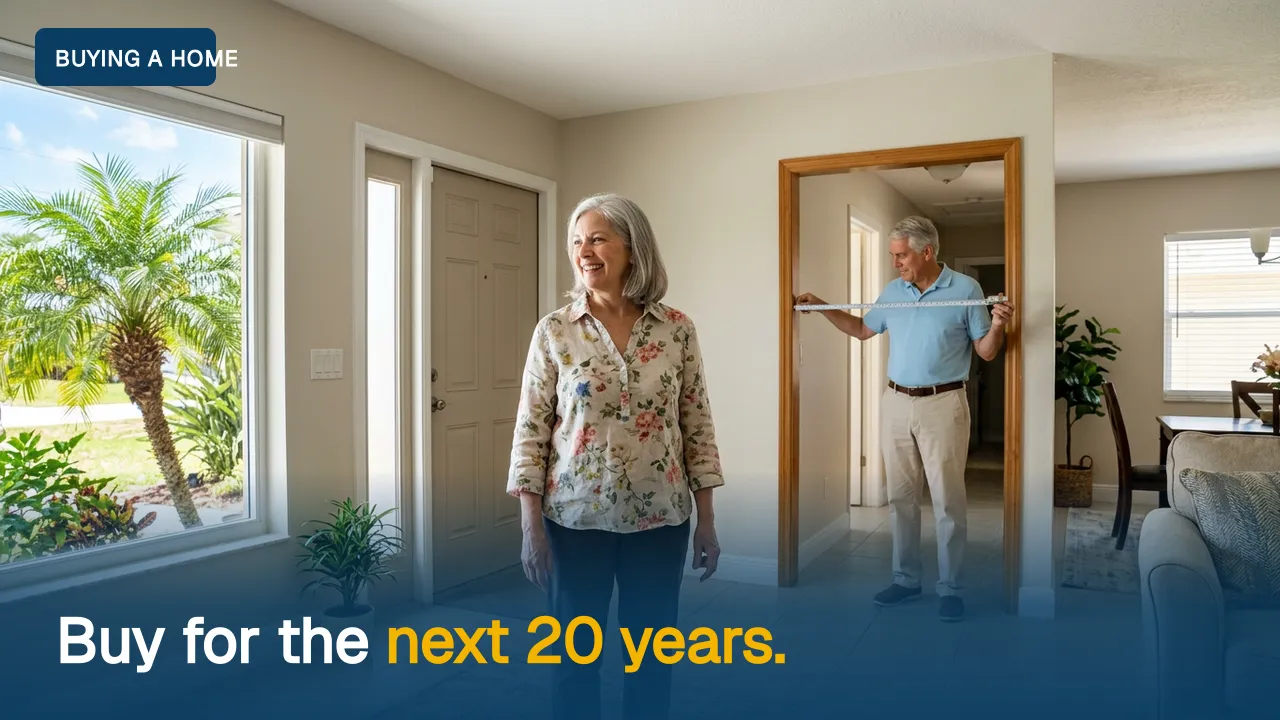
A one-story home is a good start, but it is not enough on its own. Many one-story Florida homes still have steps at every entrance, a raised garage step, a tall sliding door sill, a sunken room or a tub you have to climb into. If you plan to stay for 20 years, look for a home you can enter without steps and live in fully on one level, with a bathroom that can adapt.
One story is not the same as accessible
Harvard's Joint Center for Housing Studies looked at the U.S. housing stock using federal survey data.
| Feature | Share of U.S. homes |
|---|---|
| Bedroom and bathroom on the entry level | 73% |
| No-step entry or a ramp | 54% |
| Both a no-step entry and single-floor living | 42% |
| Those two plus halls and doors wide enough for a wheelchair | Less than 4% |
The same research found that 13 percent of householders 80 and older have trouble using their own home.
Florida adds its own twists
- Flood elevation. In many flood zones, Florida's building code requires the lowest floor to sit at least 1 foot above the base flood elevation. A newer home in a flood zone may have several steps up to every door. Look up the flood zone for any address on FEMA's Flood Map Service Center.
- Hurricane-rated sliders. Impact-rated sliding doors often have tall sills to keep out wind-driven rain. That sill can catch a walker or wheelchair.
- The garage step. Many homes have one or two steps from the garage into the house, often with no railing.
- Pools and lanais. Wet surfaces and pool edges near the main outdoor living space.
- Sunken living rooms and split-level additions in older homes.
What to check on a tour
Bring a tape measure. Imagine arriving with a walker after a hip replacement.
- Entry: Is there at least one entrance with no steps? If not, is there room for a ramp at about 1 foot per inch of rise?
- Doors: Do main doors give at least 32 inches of clear opening? Measure the bathroom door.
- Hallways: Are they wide enough to turn a walker or wheelchair into a room?
- Bathroom: Is there a walk-in shower, or a tub that could be converted? Is there space beside the toilet for a grab bar? Can blocking go in the walls?
- Bedroom: Is the primary bedroom on the main level, close to a bathroom?
- Kitchen: Is there counter space near the stove and sink for sliding pots rather than carrying them?
- Thresholds: Check every exterior door, including the lanai slider, for tall sills.
- Laundry: Is it on the main level, not in the garage down a step?
- Lighting and switches: Are switches at room entrances? Is outdoor lighting good at the entry?
- Flood zone and storm plan: Where would you go in a storm, and how would you get there with a walker or oxygen?
The National Council on Independent Living's visitability standard is a good minimum: one zero-step entrance, 32-inch clear doors, and at least a half bath on the main floor.
Buy for the next 20 years, not the next 2
Most people buy based on how they move today. A better question is how you would live in this home after a knee replacement, a stroke, or with a spouse who uses a wheelchair. Changes that are cheap before you move in, such as bathroom blocking or a wider door, can be expensive or impossible later.
Our Right Home Assessment
Before you commit to a home, we can tour it with you or review it by video. We look at the home against how you and your partner move now, and what is likely in the years ahead. You get a written report on what works, what can be changed and roughly how hard each change would be. Start with an Initial Consultation, a 30-minute phone call. Current prices are on our pricing page.
Sources
- Scheckler S. (2022). Accessibility of the U.S. housing stock. Harvard Joint Center for Housing Studies.
- U.S. Department of Housing and Urban Development. Accessibility in housing: findings from the 2019 American Housing Survey
- National Council on Independent Living. About visitability
- FEMA. Flood Map Service Center
- Florida Division of Emergency Management. Florida Building Code flood provisions, 7th edition
- AARP. HomeFit Guide
- U.S. Access Board. Guide to the ADA Standards: entrances, doors and gates